
When the Money Laundering Bridge Crossed Itself: The Rivera Verdict, the ActBlue Boston Filing, and the 23-Year Continuing Enterprise
An analytical examination of why the legal frame governing the documentary record changed on May 1, 2026, and what the post-verdict numbers actually look like.

By Christopher P. Gleason
CEO and Co-Founder, RealTruth.AI
Election Integrity Analyst, The Justice Society
Declared Candidate, United States Senate (Florida 2026), FEC Committee C00936534
Two Filings, One Day
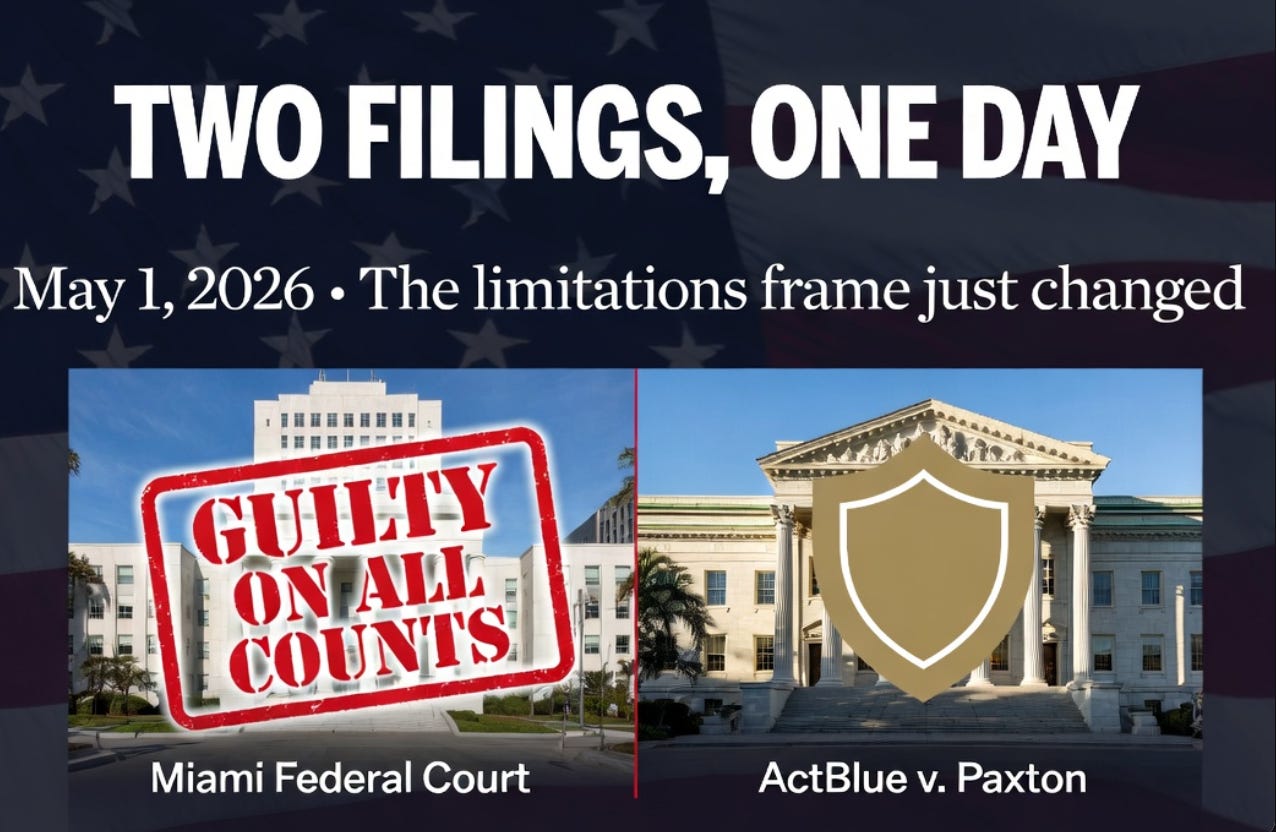
On May 1, 2026, two federal court events happened that the press has not yet connected.
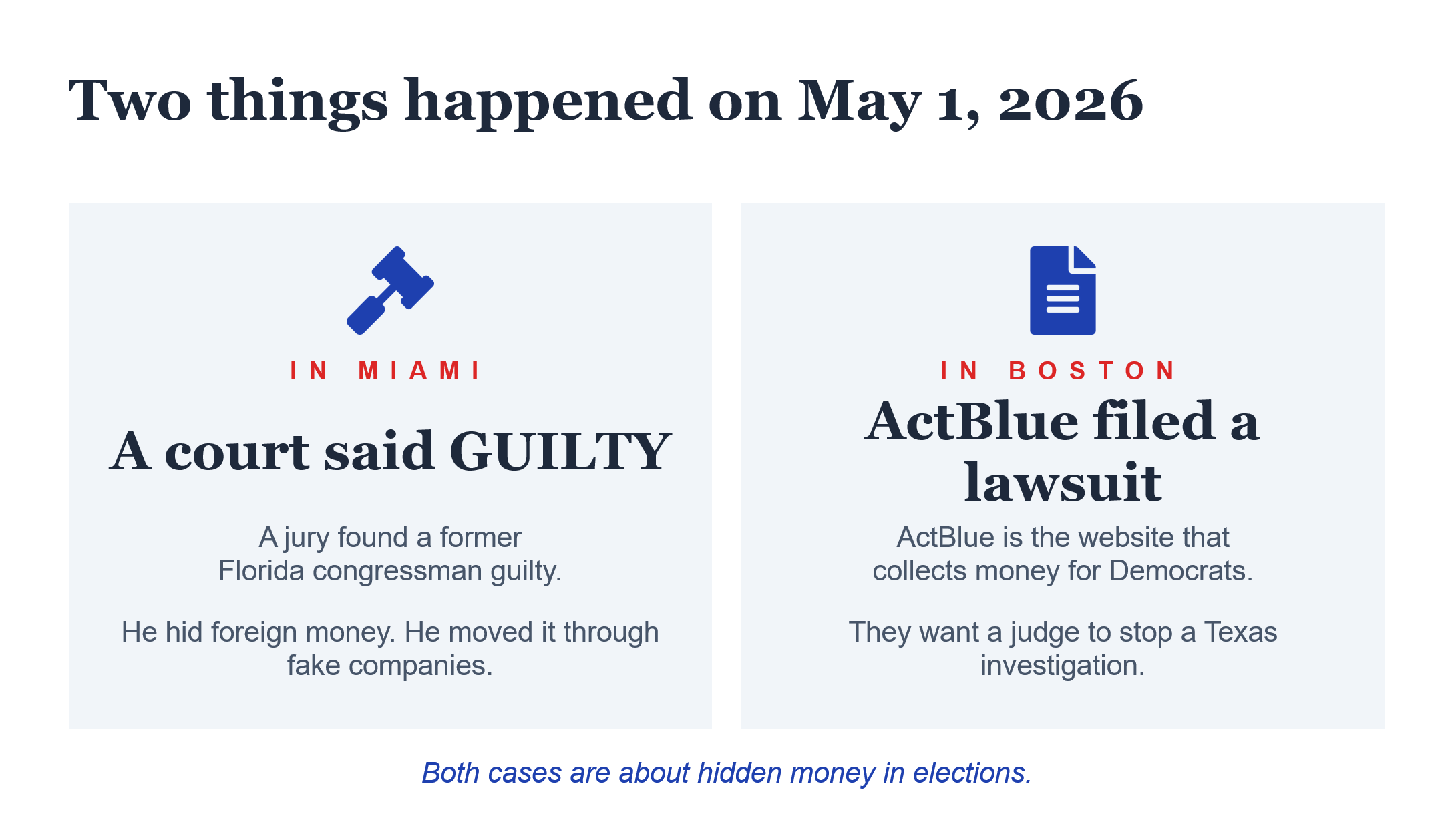
In Miami, a federal jury in the United States District Court for the Southern District of Florida returned a verdict in United States v. Rivera and Nuhfer, Case No. 1:22-cr-20552, before Judge Melissa Damian. Both defendants were convicted on all counts: conspiracy to violate the Foreign Agents Registration Act under 18 U.S.C. 371, substantive FARA violations under 22 U.S.C. 612 and 618, conspiracy to commit money laundering under 18 U.S.C. 1956(h), and four substantive counts of engaging in monetary transactions in criminally derived property under 18 U.S.C. 1957. David Rivera, a former United States Representative from Florida’s 25th Congressional District, was remanded into federal custody as a flight risk pending sentencing. Forfeiture exposure on the convicted counts is approximately $20 million on a $50 million PDV USA contract that the government proved was sourced to the Venezuelan government through layered intermediary entities.
The same day, in Boston, ActBlue LLC and three affiliated entities filed a 41-page First Amendment retaliation complaint against Texas Attorney General Ken Paxton in the United States District Court for the District of Massachusetts, captioned ActBlue LLC et al. v. Warren Kenneth Paxton, Jr., Case No. 1:26-cv-11986-RGS. The complaint alleges that Paxton’s investigative demands, his April 20, 2026 Tarrant County civil enforcement action under the Texas Deceptive Trade Practices Act, and his accompanying public statements violate the First and Fourteenth Amendments because they constitute retaliation against ActBlue for facilitating donations to Democratic candidates and progressive causes.
These two events share more than calendar coincidence. They share an analytical center. Both arise from foreign-source or otherwise tainted money flowing through intermediary entities into United States political channels. One has just been adjudicated by a federal jury. The other is a defensive holding action filed against the prospect of similar adjudication.
But the more consequential observation is this: on May 1, 2026, the legal framework governing how the documentary record underlying the Tarrant County DTPA enforcement should be evaluated changed. Not slightly. Decisively. The body of evidence that for two years has been analyzed under the conservative limitations rules of the Federal Election Campaign Act is now subject to an entirely different limitations regime, one that reaches more than two decades into the past, multiplies per-transaction exposure across hundreds of thousands of monetary transactions, and validates a forfeiture methodology against vendor and committee defendants who have not yet been named in any pleading.
This article walks through the analytical shift, the numbers that the post-Rivera frame unlocks, and what that means for the institutional enforcement environment over the next 90 days. It draws exclusively from filed pleadings, Congressional subpoena findings, FEC Schedule A bulk data, USPS Delivery Point Validation records, and the public docket in Rivera. The factual record is government data. What changed on May 1 is which body of law now applies to it.
What Changed on May 1: The Limitations Frame
To understand why the Rivera verdict reshapes the analytical universe, it is necessary to understand the limitations frame that governed it.
Federal Election Commission civil enforcement under 52 U.S.C. 30109 operates under a five-year statute of limitations. Reasonable analysts examining the conduit architecture before May 1, 2026 properly distinguished actionable-period evidence (2021-2026) from historical pattern evidence (2003-2020). My March 1 ActBlue FEC complaint adopted exactly this framework at paragraph 56: “The complaint separates actionable-period evidence (2021-2026, within the 5-year statute of limitations) from historical pattern evidence (2003-2020). Historical data demonstrates the scheme’s duration and evolution but is not the basis for relief.” That distinction was correct on March 1 because the complaint was filed under FECA. It is no longer the controlling distinction after May 1 because the Rivera verdict validated a different statutory frame.
Three doctrinal shifts changed the limitations universe on May 1:
The 10-year statute of limitations under 18 U.S.C. 3294. Money laundering offenses under 18 U.S.C. 1956 and 1957 are governed by a 10-year statute of limitations rather than the 5-year general federal criminal limit. Congress enacted this extension in the USA PATRIOT Act precisely because money laundering schemes typically take longer than five years to detect, investigate, and prosecute. The Rivera jury’s 1956(h) conspiracy conviction and four 1957 transaction convictions establish that this 10-year frame governs analogous fact patterns. Conduct that pre-existed the FEC’s 5-year window by up to five years is now within reach.
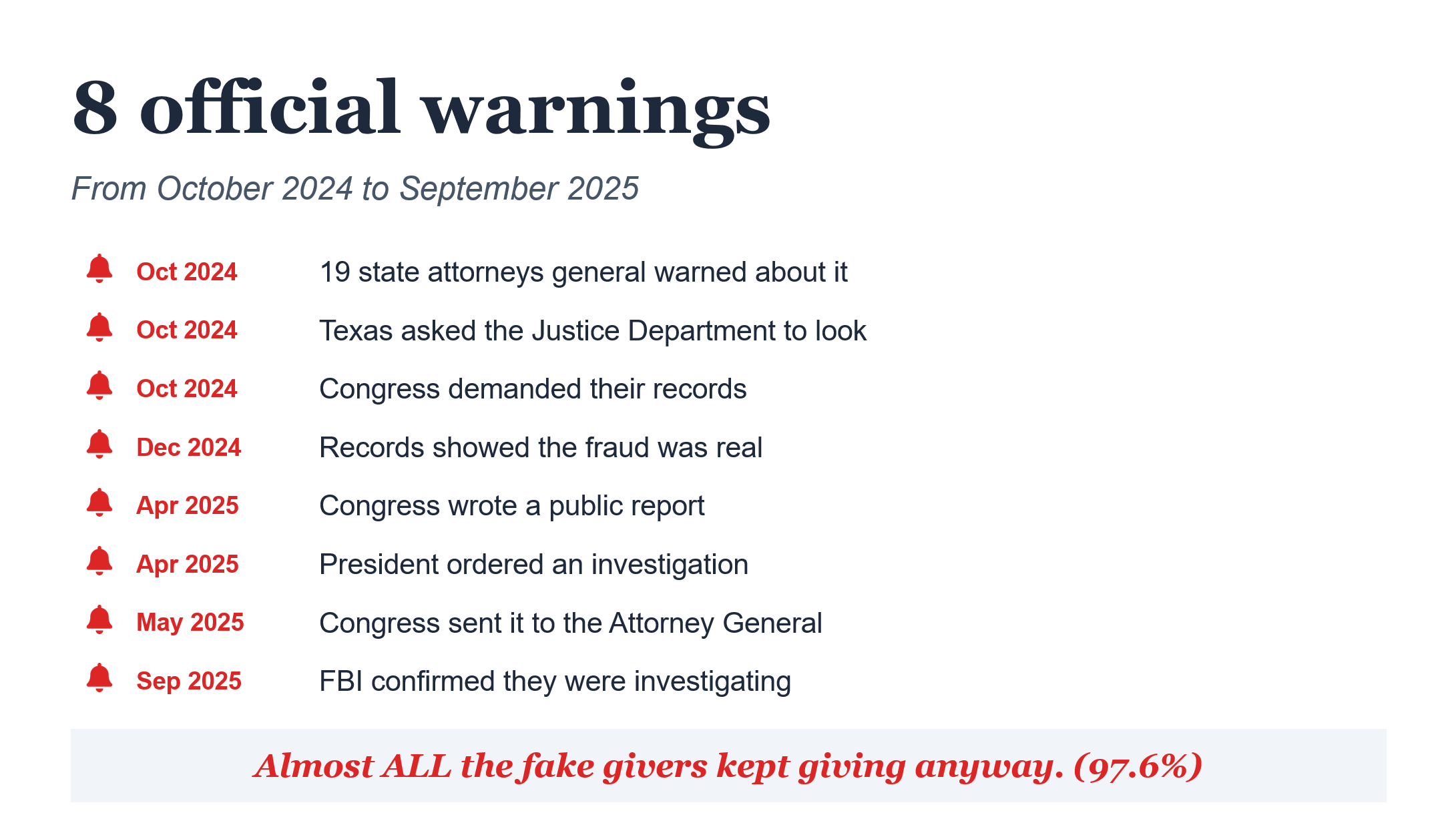
The continuing offense doctrine for conspiracy. The Supreme Court held in Smith v. United States, 568 U.S. 106 (2013), that the statute of limitations for a federal conspiracy charge runs from the last overt act in furtherance of the conspiracy, not from the formation of the conspiracy. As long as overt acts continue, the conspiracy is alive and the limitations clock has not started running. Each subsequent contribution made under a fabricated identity, each subsequent disbursement of smurf-derived funds to a recipient committee, and each subsequent committee-to-vendor payment over $10,000 is a candidate overt act in furtherance of an ongoing conspiracy. The conspiracy did not terminate when the eight-event notice cascade between October 2024 and May 2025 should have produced corrective action. Per the documentary record, 97.6% of donors at USPS-confirmed non-existent addresses continued contributing without interruption after the notice cascade. The conspiracy demonstrably continued. The limitations clock did not start.
The continuing enterprise doctrine under 18 U.S.C. 1961-1968 (RICO). The Racketeer Influenced and Corrupt Organizations Act reaches enterprises whose pattern of racketeering activity is continuing in nature. Civil RICO under 18 U.S.C. 1964(c) authorizes treble damages and attorney’s fees for any person injured in business or property by reason of a violation. The pattern requirement under 18 U.S.C. 1961(5) requires at least two predicate acts within a 10-year period, but the enterprise requirement reaches the full duration of the enterprise’s continuing operation. An enterprise that has been operating across 12 election cycles is a 23-year enterprise even if individual predicate acts must satisfy the shorter pattern window.
Fraudulent concealment tolling. When the underlying offense involves active concealment, the limitations period is tolled until the fraud could reasonably have been discovered through the exercise of due diligence. The documentary record establishes that the conduit architecture was actively concealed through fabricated donor identities at non-existent addresses, batch-generated identity clusters, sub-$200 structuring engineered to evade itemization disclosure, and earmark routing designed to disguise the true source of contributions. Under standard fraudulent concealment doctrine, the limitations clock did not begin to run until the eight-event notice cascade made the fraud reasonably discoverable, beginning October 1, 2024.
The combined effect of these four doctrinal frames is that the analytical universe controlling the documentary record on May 1, 2026 expanded from a 5-year window covering approximately $5.2 billion in smurf-tier ActBlue contributions to a 23-year continuing enterprise window covering substantially larger figures. Those figures, drawn from the same SmurfHunter forensic platform that produced the original 5-year analysis, are presented below as the post-Rivera analytical baseline.
The Pre-Rivera Numbers (The Floor)
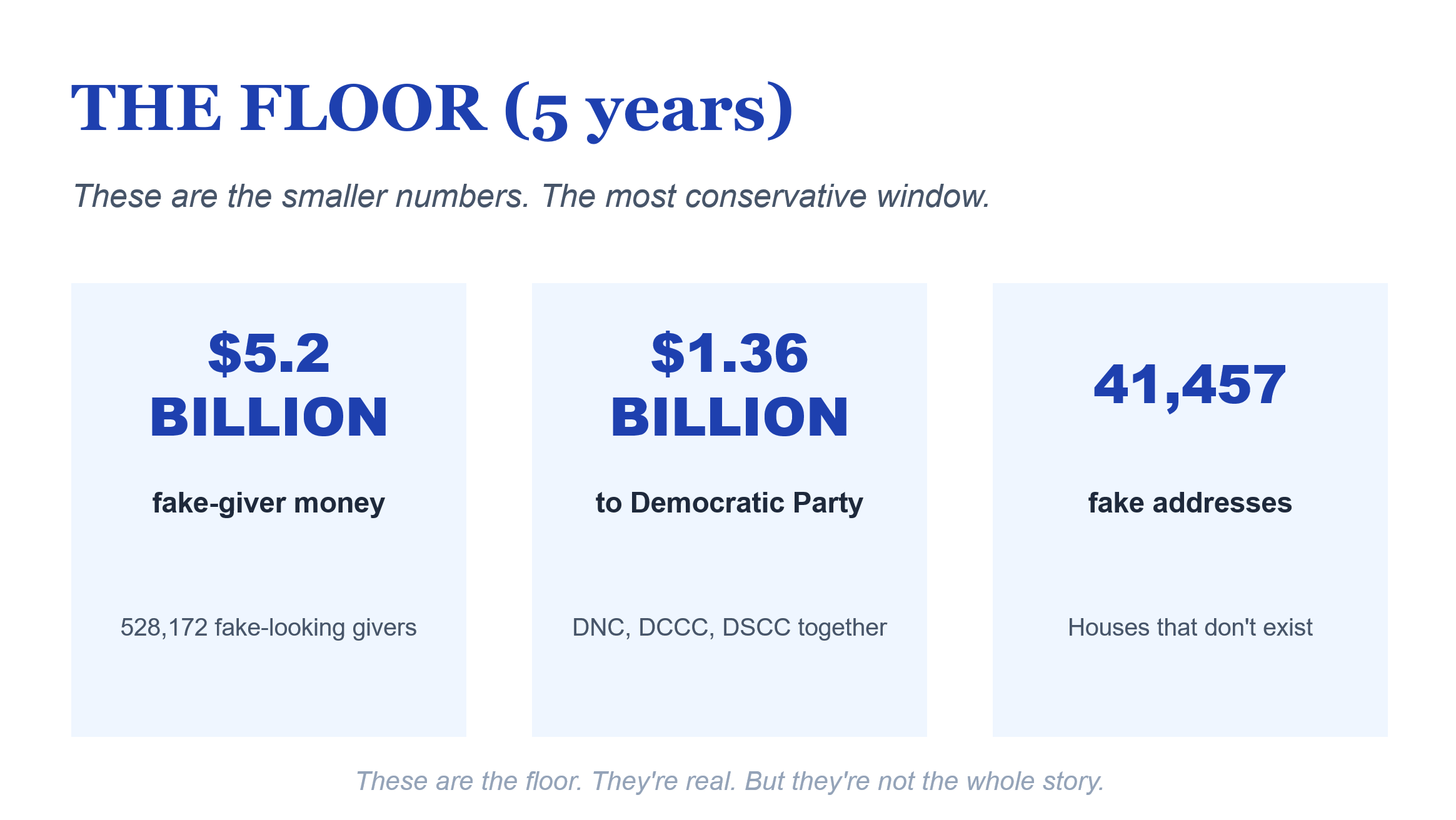
The five-year FECA window numbers are familiar to anyone who has read the underlying complaints. They are the floor of what the documentary record supports under the most conservative limitations frame:
528,172 individual donor identities made 245,066,326 contributions totaling $5,199,578,641.04 at volumes physically impossible for legitimate individual donors. 1,314 IMPOSSIBLE-tier donors each made more than 10,000 contributions per election cycle. 41,457 unique donors generated 144,349 contributions from USPS-confirmed non-existent addresses.
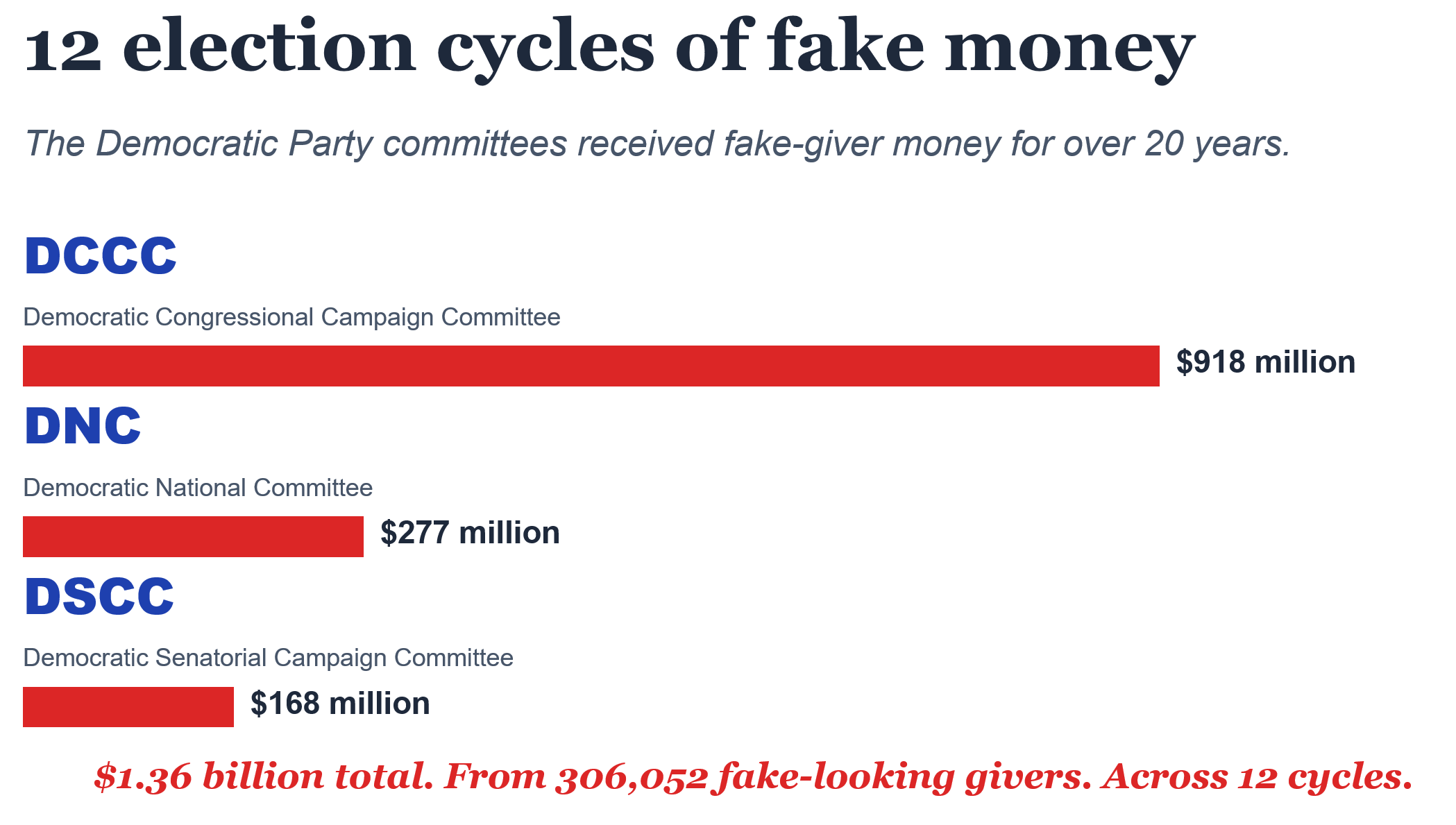
The Democratic National Committee, Democratic Congressional Campaign Committee, and Democratic Senatorial Campaign Committee collectively received $1,362,866,217 from 306,052 smurf-tier donors. 99.6% of those contributions were below $200, at an average of $28.67 per transaction. 402,872 donor identities exceeded the $200 aggregate per-cycle threshold without ever making a single contribution of $200 or more.
These numbers were the basis for my March 1 FEC complaint. They establish a prima facie case under 52 U.S.C. 30122 (contributions in the name of another), 52 U.S.C. 30121 (foreign national contributions), 52 U.S.C. 30116 (excessive contributions), 52 U.S.C. 30104 (reporting violations), and 11 C.F.R. 110.6 (conduit compliance failures). They support a disgorgement request ranging from $328 million (highest-confidence enforcement targets only) to $5.2 billion (full smurf-tier population).
These numbers are the floor.
The Post-Rivera Numbers (The Continuing Enterprise)
After May 1, 2026, the analytical universe expands. The continuing enterprise architecture documented in the SmurfHunter forensic platform, drawn from the same 1.08 billion FEC Schedule A records and 430-plus detection methodologies that produced the 5-year numbers, supports the following post-Rivera figures:
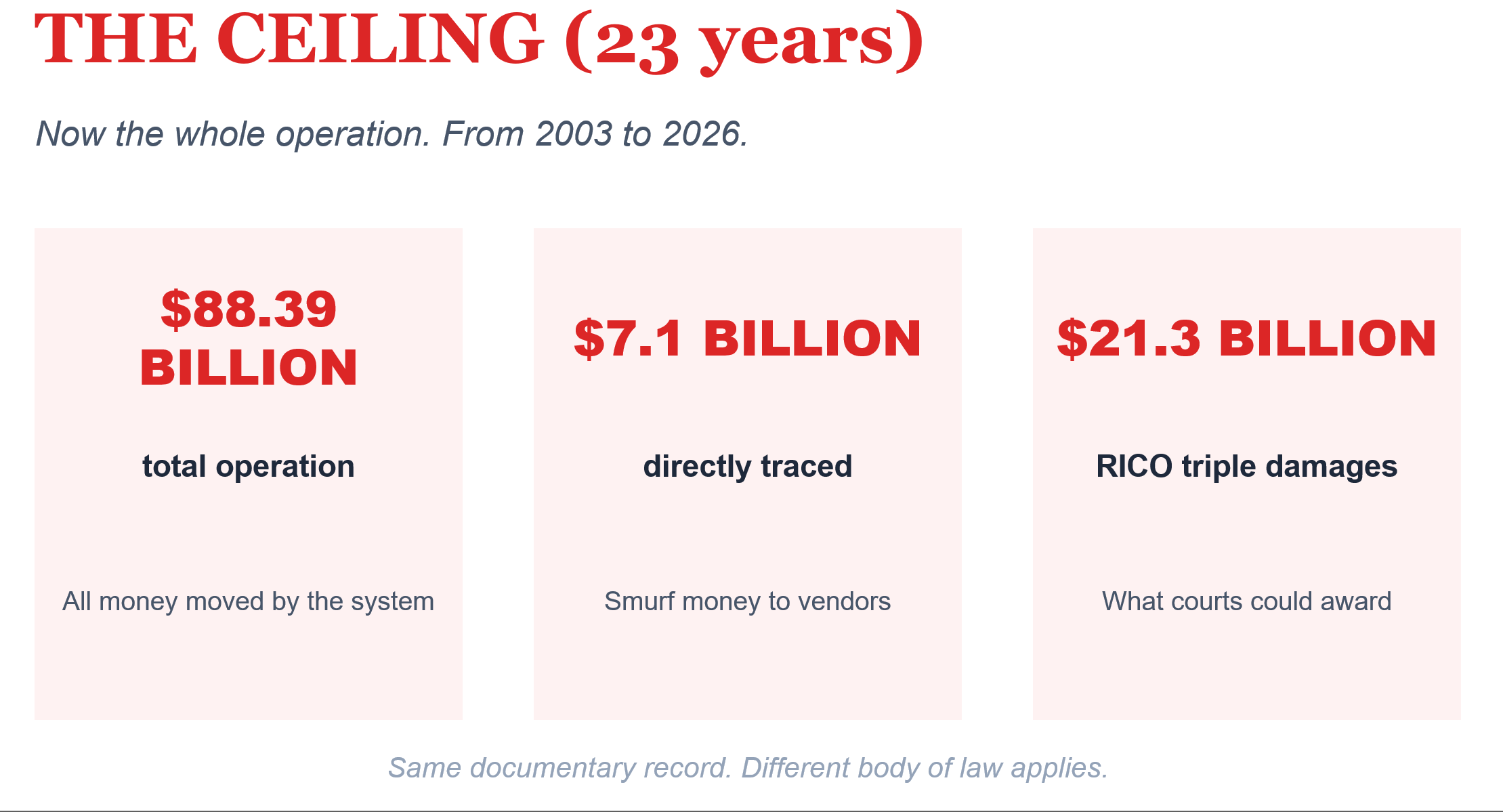
$88.39 billion enterprise volume. This is the full Schedule B disbursement architecture across all smurf-connected committees and downstream vendor relationships across the 23-year enterprise window. It captures every disbursement from a committee that received contributions from the documented smurf donor population to any vendor receiving over the relevant Schedule B reporting threshold across cycles 2003-2026. The figure represents the institutional financial volume of the enterprise, not the smurf-attributable portion alone, but it is the universe within which the 1956/1957/1961-68 framework operates.
$119 billion in Schedule B disbursements from smurf-connected committees across 7 election cycles 2013-2026, per paragraph 28 of the March 1 complaint. The disbursements include the documented $5.2 billion in identifiable smurf-tier inflows plus the operational disbursements those inflows funded, including consultant payments, JFC redistributions, vendor relationships, and internal transfers.
$7.1 billion in directly attributable smurf-derived flows across the continuing enterprise window. This is the smaller, more conservative subset of the $88.39 billion enterprise figure that traces specifically through the documented smurf-tier donor population to specific recipient committees and onward to specific vendor relationships. It is the figure most directly comparable to Rivera’s $50 million underlying contract.
$21.3 billion in candidate civil RICO treble damages under 18 U.S.C. 1964(c). Civil RICO authorizes treble damages plus attorney’s fees for any person injured by reason of an enterprise violation. Applied to the $7.1 billion directly attributable enterprise volume, the treble damages calculation produces $21.3 billion. The figure is a candidate exposure, not a prediction of recovery, and would require federal-court adjudication of the enterprise theory.
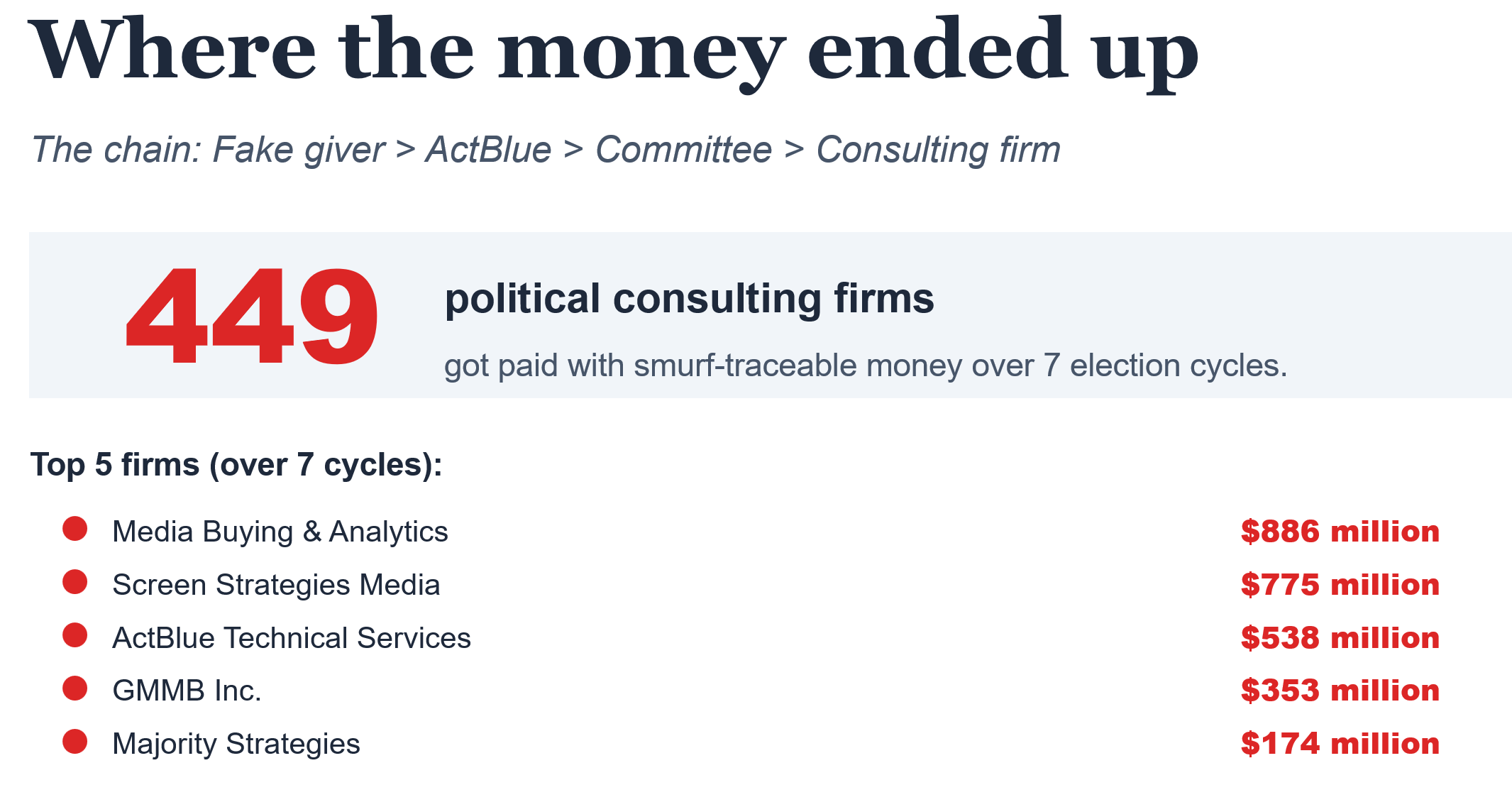
449 political consulting firms identified as terminal recipients of smurf-derived funds across the continuing enterprise window. These are the firms that received Schedule B disbursements from smurf-connected committees over multiple cycles. Top FEC-level recipients by aggregate volume across 7 cycles include Screen Strategies Media ($775 million across 128 committees), ActBlue Technical Services itself ($538 million across 2,088 committees), GMMB Inc. ($353 million across 139 committees), Majority Strategies ($174 million across 194 committees), and Media Buying & Analytics ($886 million across 47 committees).
489 complete money chains reconstructed running fabricated smurf donor through ActBlue conduit through campaign committee to political consulting firm vendor.
12 election cycles of continuing operation (2003-2026). The smurf-tier donor identities documented in the complaint exhibit contribution patterns that extend across multiple cycles. IMMASCHE, SONIA’s contribution period runs from January 10, 2006 through July 11, 2024 (over 18 years). KESKITALO, CANDACE runs from March 30, 2012 through June 30, 2025 (over 13 years). URBANOWICZ, WENDY runs from January 13, 2020 through October 29, 2025 (nearly 6 years, with 24,122 contributions across that span and 544 implausible days exceeding 20 contributions). GOLDSTEIN, RICHARD runs from January 10, 2014 through October 31, 2025 (nearly 12 years, with 27,852 contributions across 230 committees). These multi-cycle, multi-decade spans are not artifacts of methodology. They are the documentary record of a continuing enterprise.
The arithmetic shift between the pre-Rivera and post-Rivera frames is approximately one order of magnitude on the conservative directly-attributable figure ($7.1 billion vs. $5.2 billion is roughly the 5-cycle vs. 12-cycle ratio when weighted by per-cycle volume), and approximately three orders of magnitude on the full enterprise figure ($88.39 billion vs. $5.2 billion is the institutional volume vs. attributable inflows). The Rivera precedent does not change any factual finding in the documentary record. It changes which body of law governs the evaluation of those findings.
The MARY Cluster Reframed
Section III-J(D) of my March 1 complaint documents what is, in the author’s professional view, the single most analytically significant finding in the entire forensic record: 113 different donors with the first name MARY, with 113 different last names, located across 34 states, all making EXACTLY 24 contributions totaling EXACTLY $120.00 during the 2023 to 2024 election cycle. A second MARY cluster shows 60 different last names across 26 states, all at exactly 24 contributions for exactly $240.00. A third shows 38 last names across 21 states at exactly 24 contributions for $360.00.
The pattern extends. 20 different DAVIDs across 14 states each made exactly 48 contributions for exactly $264.00. 17 MICHAELs across 10 states each made exactly 48 contributions for $132.00. 16 JOHNs across 12 states each made exactly 48 contributions for $144.00. The recurring cluster at exactly 48 contributions appears across DAVID, MICHAEL, JOHN, JAMES, SUSAN, THOMAS, MARY, JOSEPH, ROBERT, SARAH, ELIZABETH, RICHARD, PAMELA, BARBARA, and PAUL.
The probability of 113 unrelated individuals in 34 states independently making the exact same number of contributions for the exact same total dollar amount is, as a matter of statistics, zero. This is direct evidence of batch-generated identity fabrication.
Pre-Rivera, this finding read as a single-cycle statistical anomaly that supported the 30122 contribution-in-the-name-of-another theory. Post-Rivera, the same finding does additional analytical work. Exhibit E of the March 1 complaint documents 42 high-volume clone pairs (donors sharing a first name, having different last names, and producing identical contribution counts and dollar totals) that include 18 pairs from the 2009-2010 cycle alone at exactly 132 or 134 contributions. The batch-processing pattern has persisted across multiple election cycles.
That persistence is the evidentiary signature of a continuing enterprise. Under the conspiracy continuing-offense doctrine, an automated identity-generation system producing the same statistical signatures in 2009-2010 and again in 2023-2024 is not two unrelated events; it is one continuing enterprise with overt acts spanning at least 14 years. The MARY cluster in 2023-2024 is the contemporary visible portion of an enterprise architecture whose batch-generation infrastructure has been documented in FEC records since the 2009-2010 cycle.
The Rivera framework does not require that the specific MARY cluster’s individual transactions cross the §1957 $10,000 threshold (most do not, since each individual MARY’s transactions average $5.00). The Rivera framework requires that monetary transactions in criminally derived property cross the $10,000 threshold somewhere in the laundering chain. The chain runs: 113 fabricated MARY identities collectively generate $13,560 in 2023-2024 cycle contributions; that $13,560 is aggregated through ActBlue’s conduit into committee receipts; the committees disburse over $10,000 increments to vendors; each disbursement of laundered funds over $10,000 is an independent §1957 count. The MARY cluster is the predicate; the §1957 multiplier operates downstream.
Mapping the Rivera Framework to the Continuing Enterprise
The §1956/§1957 statutory chain that the Rivera jury validated maps onto the continuing enterprise architecture documented above. Walk through the chain:
The predicate offense, expanded. 52 U.S.C. 30121 (foreign national contributions) is a felony when knowing and willful and the aggregate amount exceeds $25,000 in a calendar year. 52 U.S.C. 30122 (contributions in the name of another) is a felony when knowing and willful and the aggregate exceeds $10,000. Both statutes are reachable as money laundering predicates under 18 U.S.C. 1956(c)(7) through the cross-reference to 18 U.S.C. 1961(1) RICO predicates. The forensic record establishes both predicates at scale across the continuing enterprise window: $6.98 million in foreign-flagged contributions to DNC, DCCC, and DSCC alone over 12 cycles; $397,985.99 in iGas/CCP-traceable contributions to DeSantis-affiliated entities documented in Track 4 of the March 26 DeSantis complaint; and the full $5.2 billion smurf-tier population qualifying as 30122 violations because contributions made in the names of fabricated identities at non-existent addresses are by definition contributions made in the name of another.
The 5-year FEC frame caps the predicate analysis at conduct from 2021 forward. The 10-year SOL under 18 U.S.C. 3294, plus continuing-offense tolling, extends the predicate window to conduct from 2016 forward at minimum and to the full 2003-2026 enterprise window where conspiracy and enterprise theories control. The number of qualifying predicate acts grows by approximately a factor of 2.4 in the 10-year window and by approximately a factor of 4.6 in the full enterprise window.
The concealment function, persistent. Rivera turned on the use of intermediary entities to disguise the foreign-government origin of the money. The conduit architecture performs the same concealment function with three documented mechanisms persisting across the continuing enterprise window: fabricated donor identities at non-existent addresses (41,457 unique donors per the USPS DPV record, with the underlying identity-generation system documented from the 2009-2010 cycle); batch-generated identity clusters (the MARY, DAVID, JOHN, JAMES, SUSAN, THOMAS, JOSEPH, ROBERT, SARAH, ELIZABETH, RICHARD, PAMELA, BARBARA, and PAUL clusters, with the same statistical signature appearing across multiple cycles); and sub-$200 structuring designed to evade the 52 U.S.C. 30104(b)(3)(A) itemization disclosure requirement. The structuring pattern is the campaign finance analog to 18 U.S.C. 5324, and it persists across the full enterprise window.
The monetary transactions over $10,000, multiplied across cycles. This is where the Rivera §1957 framework becomes consequential at full enterprise scale. Each monetary transaction in criminally derived property exceeding $10,000 is an independent §1957 count carrying a maximum sentence of ten years. Track 6 of the March 26 DeSantis complaint already estimated 24,190-plus candidate §1957 counts based on daily aggregate deposits exceeding $10,000 in smurf-derived funds within a single political infrastructure. Apply the same methodology to the broader conduit architecture across 23 years: ActBlue processes approximately 750,000 transactions per week. Daily disbursement aggregates from ActBlue to recipient committees, from recipient committees to JFC redistribution accounts, and from committees to political consulting vendors routinely exceed $10,000. Across 23 years of continuing operation, the candidate §1957 count exposure for the broader enterprise reaches into the hundreds of thousands of transactions when applied at the conservative aggregation methodology used in the DeSantis Track 6 estimate.
The mens rea, established across the full window. §1956 requires knowledge that the property derives from some form of unlawful activity. The forensic record on mens rea is unusually strong and operates across the continuing enterprise window. For ActBlue specifically, the 22 internal fraud campaigns identified by ActBlue’s own records (per Congressional subpoena), the deliberate weakening of fraud-prevention controls in April and September 2024, the documented training to “look for reasons to accept contributions,” and the testing of CVV implementation impact on fundraising before deciding to implement the standard e-commerce security feature in August 2024 all establish actual knowledge during the most recent cycle. For the recipient committees (DNC, DCCC, DSCC, and the candidate committees that received earmarked contributions), the eight-event official notice cascade between October 2024 and May 2025, plus the March 1, 2026 service of the FEC complaint, plus the May 1, 2026 Rivera verdict, establish constructive notice on a triple-layered record. The conspiracy continuing-offense doctrine extends the mens rea analysis backward from each documented post-notice acceptance event because the conspiracy did not terminate.
The Forfeiture Math Recalibrated
The Rivera forfeiture exposure is approximately $20 million on a $50 million underlying contract, representing roughly 40 percent of gross proceeds. That ratio is illustrative rather than predictive; actual forfeiture analysis requires per-transaction tracing and applies the commingled-funds methodology under 18 U.S.C. 984. With the post-Rivera continuing enterprise frame, the forfeiture math expands materially.
Apply the Rivera ratio to the documented continuing enterprise figures:
Pre-Rivera frame (5-year FEC window):
ActBlue full smurf-tier total of $5,199,578,641: approximately $2.08 billion in candidate forfeiture exposure
DNC/DCCC/DSCC combined smurf exposure of $1,362,866,217: approximately $545 million
Top consulting firms aggregate over 5 years of approximately $850 million: approximately $340 million
Post-Rivera frame (continuing enterprise window):
Full enterprise volume of $88.39 billion: approximately $35.4 billion in candidate institutional reference exposure
Directly attributable smurf-derived flows of $7.1 billion: approximately $2.84 billion in candidate forfeiture exposure
Top five consulting firms aggregate over 7 cycles of approximately $2.7 billion: approximately $1.08 billion in candidate vendor forfeiture exposure
iGas/CCP-specific track at $3,796,954.55 across 156 committees: approximately $1.5 million (the smallest, cleanest, and most analytically tractable case to bring first)
The §1957 transaction multiplier operates orthogonally to the forfeiture math. Each individual monetary transaction in criminally derived property over $10,000 is reachable for forfeiture as a substitute property under 18 U.S.C. 982 even when the original tainted funds have been commingled with legitimate funds. The Rivera precedent’s commingled-funds tracing methodology under 18 U.S.C. 984 reaches every disbursement of laundered funds within one year of the deposit. Across the continuing enterprise window, the cumulative §1957 transaction-based forfeiture exposure is independent of (and additive to) the percentage-of-gross-proceeds methodology above.
These numbers are not predictions of recovery. They are structural reference points calibrated against the only directly comparable federal jury verdict for foreign-source-money laundering through political-channel intermediaries that the federal courts have produced. The institutional baseline against which DOJ Public Integrity will be evaluating this conduit architecture is now Rivera. The architecture is several orders of magnitude larger than the case the Rivera jury just convicted on, and it operates over a substantially longer window than the FEC’s 5-year frame contemplates.
The Eight-Event Notice Cascade as Conspiracy Evidence
The mens rea question for the recipient committees and conduit operators turns on what they knew and when. The post-Rivera analytical frame reframes the eight-event notice cascade not just as evidence of constructive notice for FECA enforcement purposes but as direct documentary evidence that the conspiracy did not terminate after notice and is therefore subject to the continuing-offense rule.
The public record establishes the following sequence of formal notice events that occurred before the Rivera verdict:
October 1, 2024: A coalition of 19 state attorneys general transmitted a letter to the United States Department of Justice requesting investigation of conduit platform contribution anomalies. The signatories included Republican attorneys general from Iowa, Indiana, and 17 other states.
October 24, 2024: The Texas Attorney General transmitted a formal criminal referral to DOJ alleging systematic straw donor violations on the ActBlue platform.
October 28, 2024: The House Administration Committee issued a formal demand for conduit platform contribution records.
October 30, 2024: The Joint House Investigation issued a Congressional subpoena for IP logs, device fingerprints, fraud detection system data, and internal communications regarding contributor screening.
December 10, 2024: Initial subpoena findings identified systematic contribution anomaly patterns and the 22 internal fraud campaigns.
April 2, 2025: The Joint Staff Report was published, documenting the conduit platform irregularities and the deliberate 2024 fraud-control reductions in detail.
April 24, 2025: A Presidential Memorandum directed DOJ to investigate conduit contribution integrity.
May 7, 2025: Three Congressional committees (Administration, Judiciary, Oversight) formally referred their investigation findings to the Attorney General.
September 2, 2025: FBI Headquarters provided a classified briefing to House Administration Committee Chairman Bryan Steil confirming “a number of active investigations into campaign finance violations” related to the platform.
By the time the Rivera verdict landed on May 1, 2026, the recipient committees and the conduit operator had been on documented constructive notice for 19 months. The forensic record documents that 97.6 percent of donors at USPS-confirmed non-existent addresses continued contributing without interruption after the eight-event notice cascade.
Pre-Rivera, this 97.6 percent persistence rate was evidence of post-notice continuation supporting enhanced FECA penalties under 52 U.S.C. 30109(d). Post-Rivera, the same persistence rate is evidence that the underlying conspiracy did not terminate. Under Smith v. United States, the conspiracy’s continuing operation extends the limitations clock backward to the formation of the original enterprise, which the documentary record establishes as no later than the 2003-2004 cycle when the first qualifying batch-generation patterns appear in FEC records. The 97.6 percent persistence rate is therefore the analytical bridge between the contemporary conduct (within the 5-year FECA window) and the historical pattern (across the 23-year enterprise window). It establishes that the historical pattern is not history; it is the predicate evidentiary record of an ongoing conspiracy.
What This Means for Recipient Committees
After the Rivera verdict, the analytical question for every recipient committee that has continued to accept contributions from the documented smurf donor population has changed character.
Pre-Rivera, accepting contributions from documented smurf donors after the eight-event notice cascade was administrative exposure: potential FEC enforcement, potential disgorgement of post-notice receipts, potential civil penalties under 52 U.S.C. 30109(a)(6) limited to the 5-year window.
Post-Rivera, the same conduct is potentially §1956 mens rea exposure for the committee, the treasurer in their personal capacity under 11 C.F.R. 103.3(b), and (in cases of candidate-committee involvement in continued solicitation) the candidate. Each subsequent disbursement of smurf-derived funds over $10,000 is a candidate §1957 count. The continuing-offense rule extends the conspiracy exposure backward across the full enterprise window where the recipient committees received contributions from the same smurf donor identities operating across multiple cycles.
The institutional Democratic committees named in the March 1 ActBlue complaint sit at the center of this exposure:
The Democratic National Committee (C00010603) received contributions from 159,816 smurf-tier donors totaling $276,779,524 across 12 election cycles, with continued acceptance after each of the eight notice events.
The Democratic Congressional Campaign Committee (C00000935) received contributions from 207,979 smurf-tier donors totaling $918,282,891 across the same period.
The Democratic Senatorial Campaign Committee (C00042366) received contributions from 85,513 smurf-tier donors totaling $167,803,802.
The combined exposure across the three committees is $1,362,866,217 from 306,052 unique smurf-tier donors over 12 cycles. Each committee’s continued acceptance of contributions after May 1, 2026 occurs against a triple-layered notice record: the eight-event Congressional notice cascade, the March 1 FEC complaint service, and the May 1 Rivera verdict.
The downstream candidate committees are similarly exposed across the continuing enterprise window. The Ossoff committees in Georgia (subject of my February 27, 2026 FEC complaint, with 94,264 smurf donors and $151.9 million in smurf-flagged contributions, and $202.4 million in ActBlue earmarks designated for Ossoff) sit in the same frame. The Talarico for Senate operation in Texas, currently a major ActBlue beneficiary, sits in the same frame for any contributions accepted after the documented notice events. The Warnock, Klobuchar, Baldwin, Schiff, Murray, Gallego, Kelly, and other Senate operations identified in the Bernegger administrative complaints filed in 2025 and 2026 sit in the same frame.
This is not a partisan observation. The DeSantis architecture documented in my March 26 complaint sits in the identical frame, with $87,993,466.69 in smurf-flagged contributions, the iGas/CCP foreign-national track at $397,985.99, and 66,281 cross-platform smurf donors appearing on both ActBlue and WinRed with $97 million in cross-network volume. The $1.36 billion DNC/DCCC/DSCC exposure and the $87.9 million DeSantis exposure exist on the same documentary record under the same legal framework that the Rivera jury just validated.
The 449 Political Consulting Firms
Section III-G of the March 1 complaint traces 489 complete money chains running from fabricated smurf donor through ActBlue conduit through campaign committee to political consulting firm. The analysis identifies 449 political consulting firms that are the terminal recipients of smurf-originated funds across the 7-cycle 2013-2026 window.
The top FEC-level recipients by aggregate volume across that window include Screen Strategies Media ($775 million in disbursements from smurf-connected committees across 128 committees), ActBlue Technical Services itself ($538 million across 2,088 committees), GMMB Inc. ($353 million across 139 committees), Majority Strategies ($174 million across 194 committees), and Media Buying & Analytics ($886 million across 47 committees).
These are vendors. They received Schedule B disbursements from committees that received smurf-tier contributions across multiple cycles. The chain is: fabricated donor identity to ActBlue conduit to committee to vendor.
The Rivera precedent establishes that vendors who received over $10,000 in monetary transactions of criminally derived property have §1957 exposure independent of any participation in the underlying conspiracy. §1957 mens rea requires only that the recipient knew the funds derived from some form of unlawful activity. After the eight-event notice cascade, the March 1 complaint, and the May 1 Rivera verdict, the constructive-notice record for the vendors is complete.
The post-Rivera analysis of vendor exposure operates across the full continuing enterprise window because each cycle’s disbursements operate as continuing acts of the same enterprise. A vendor that received smurf-traceable disbursements in 2013-2014, 2015-2016, 2017-2018, 2019-2020, 2021-2022, 2023-2024, and 2025-2026 has cumulative §1957 exposure across all seven cycles, not just the most recent. Vendors that have publicly defended their committee clients while accepting payments traceable to smurf-derived funds across multiple cycles face structurally identical exposure to the Rivera vendor relationships that were just adjudicated, multiplied across the cycles in which they participated.
The §1957 per-transaction count for the consulting firm population, applied across the 7-cycle window at the DeSantis Track 6 aggregation methodology, scales into the tens of thousands of candidate counts for the top-five firms alone. These are not predictions. They are structural reference points for the institutional baseline that DOJ Public Integrity will apply.
The Boston Filing’s Strategic Problem, Recalibrated
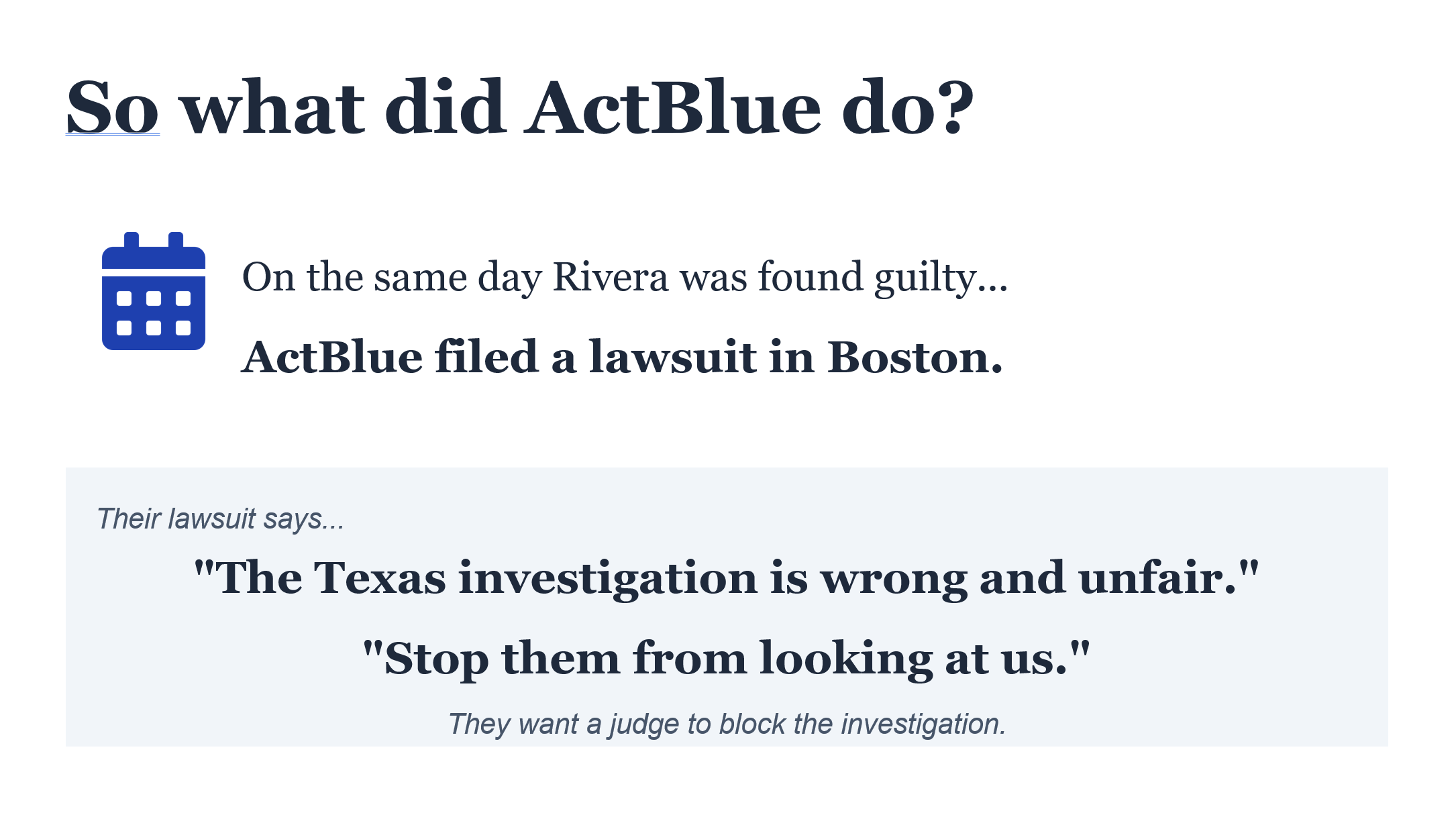
ActBlue’s First Amendment retaliation complaint, filed in the District of Massachusetts the same day the Rivera verdict came down, characterizes the underlying enforcement allegations as “false and inflammatory” at paragraph 9. The complaint at paragraphs 30 through 37 stakes the entirety of its compliance defense on two factual representations: that ActBlue uses “industry-standard fraud-detection software” with “more than 140 signals,” and that ActBlue has “implemented multiple safeguards to block political contributions that are prohibited by applicable campaign finance law.”
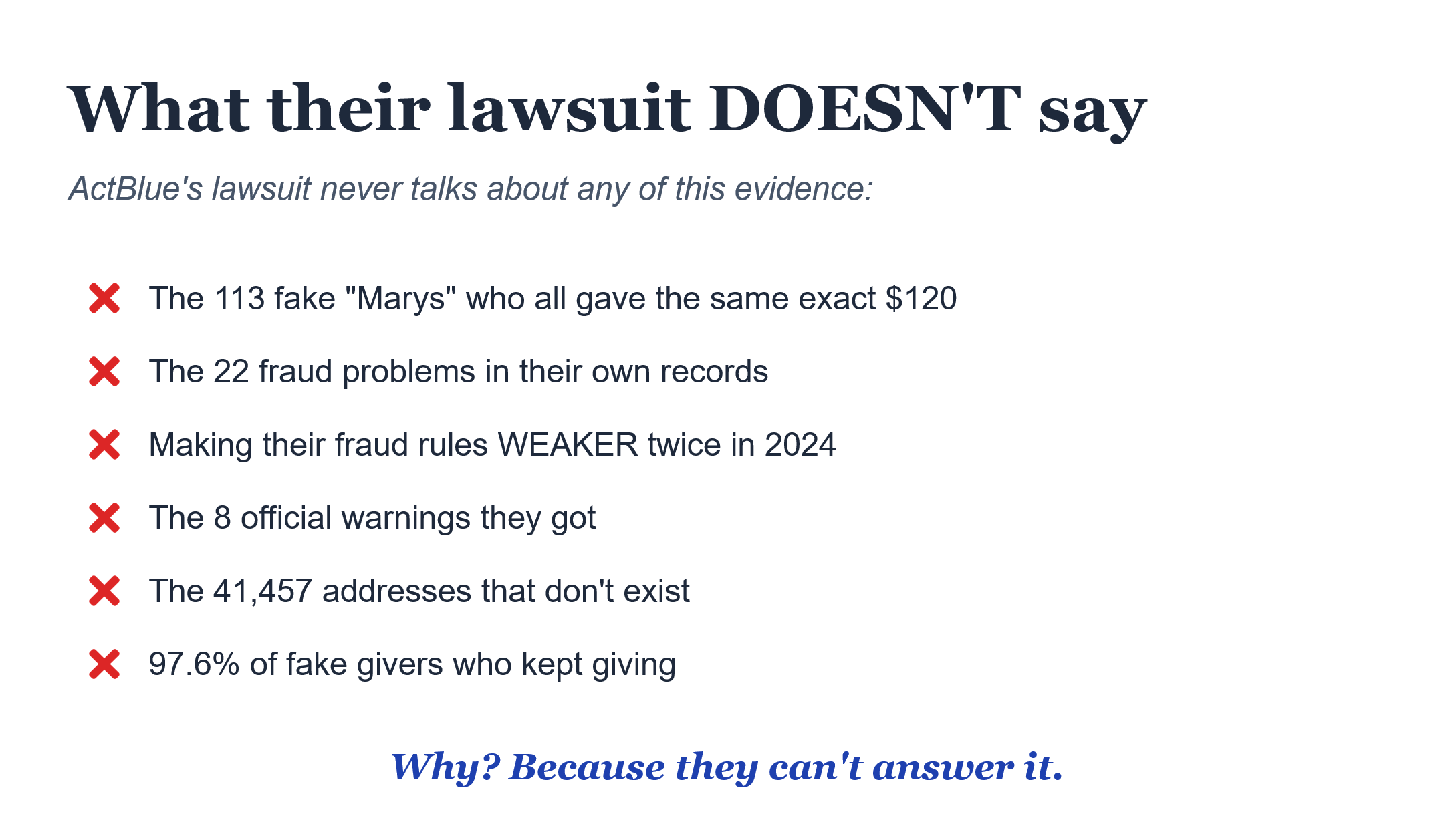
Section II of my March 1 complaint, drawn entirely from Congressional subpoena records of ActBlue’s own internal documents, contradicts each of these representations on the documentary record. ActBlue did not require CVV verification on credit card transactions until August 2024. ActBlue’s foreign-presence verification requirement was implemented “beginning in 2025.” ActBlue identified at least 22 significant fraud campaigns internally. ActBlue made fraud-prevention rules more lenient twice in 2024. ActBlue’s chief fraud-prevention official was documented as willing to accept 10 percent more fraud while reorienting the team toward DEI priorities. ActBlue’s internal training directed employees to look for reasons to accept contributions. ActBlue tested whether CVV implementation would reduce fundraising before implementing it.
The Boston complaint nowhere addresses these findings. It nowhere addresses the MARY cluster, the DAVID cluster, the JOHN cluster, the JAMES cluster, or any of the 15 named first-name identity clusters. It nowhere addresses the 41,457 donors at USPS-confirmed non-existent addresses, the 97.6 percent post-notice persistence rate, the 22 fraud campaigns identified by ActBlue’s own internal records, or the eight-event notice cascade.
The Boston complaint cannot address these findings because doing so on the record would be worse than ignoring them. The complaint’s strategic posture is therefore to win on threshold issues (personal jurisdiction in Massachusetts, Younger abstention against the Tarrant County DTPA proceeding, ripeness) and to avoid any merits adjudication at all.
This was a defensible strategy when the complaint was drafted in late April. The Rivera verdict on May 1 substantially weakens it. The Vullo coercion theory that the Boston complaint relies on requires that the underlying enforcement be objectively unreasonable. After the May 1 verdict, the underlying enforcement is, on a federal jury verdict in the same circuit, demonstrably criminally chargeable. ActBlue can no longer credibly characterize state-court civil enforcement of analogous conduct as objectively unreasonable when the same conduct, applied to a much smaller predicate, has just produced a federal criminal conviction.
The post-Rivera analytical recalibration deepens the strategic problem. The Boston complaint was filed under an implicit assumption that the relevant enforcement window would remain capped at the 5-year FECA frame. The Rivera verdict shifted that frame to the 10-year SOL and the 23-year continuing-enterprise window. ActBlue’s defensive posture in Boston is now not just defending against the conduct in the Tarrant County petition but against an enforcement universe extending across the full continuing enterprise window. The Boston complaint will probably still survive on threshold issues. It cannot survive on the merits at any limitations frame, but particularly cannot survive at the post-Rivera frame.
The DOJ Pipeline and the 90-Day Window
The institutional pipeline for DOJ Public Integrity Section action is now structurally complete. The May 7, 2025 referral by three Congressional committees to the United States Attorney General remains pending. The September 2, 2025 FBI confirmation of “active investigations” remains operative. The April 24, 2025 Presidential Memorandum directing DOJ investigation remains the controlling executive instruction.
The Rivera verdict supplies the institutional cover that DOJ has been waiting for. Declining to act on the conduit architecture after Rivera requires DOJ to defend a position that the same legal theory applies to one Florida former Congressman ($50 million Venezuelan contract) but does not apply to a $7.1 billion directly attributable continuing enterprise (operating across 23 years through fabricated identities at non-existent addresses into both major political parties) embedded in an $88.39 billion full-enterprise volume. That position is not institutionally defensible to Congress, to the press, or to any subsequent administration regardless of party.
The post-Rivera enforcement environment has a 90-day strategic window during which precedential momentum is at its peak and institutional receptiveness is highest. Three structurally consequential things are achievable in that window:
First, the Small Business Administration Office of Inspector General complaint targeting iGas-network PPP and EIDL false-certification claims becomes deliverable under the verdict-incorporated framework. The YAPP USA precedent ($43 million-plus aggregate False Claims Act settlements for Chinese-subsidiary false certifications) plus the Rivera predicate gives SBA OIG a substantially stronger institutional case for parallel-track enforcement.
Second, the FARA Unit at the National Security Division now has verdict-level basis to issue nunc pro tunc registration demands against Ballard Partners, Capitol Counsel, and Husch Blackwell for the iGas representation. This is administrative action, not criminal prosecution, and the institutional barrier to action is substantially lower after Rivera.
Third, the 52 U.S.C. 30109(a)(8) mandamus calendar in the District Court for the District of Columbia matures around June 29, 2026 for the March 1 ActBlue, Ashley Moody complaints, and on parallel timelines for the Ossoff (June 27), DeSantis (July 24), and AIPAC (July 24) complaints. Filing on schedule, with the Rivera verdict cited as supporting authority for the underlying allegations, creates a federal-court record that the same money laundering theory the Eleventh Circuit just validated against Rivera applies to the conduct documented in the administrative complaints.

The cleanest first prosecution off the Rivera precedent is the iGas/CCP foreign-national track. The case has documented SOE ownership chain (six consecutive Commerce Department determinations between 2014 and 2020 establishing the Zhejiang Provincial SASAC to Juhua Group to Zhejiang Juhua to iGas USA chain), specific contributions traced to specific recipient committees ($397,985.99 to DeSantis-affiliated entities; $3,796,954.55 across 156 committees per OFAC Petition Exhibit G), pending FEC matters under MUR 8437 and MUR 8439 (acknowledged March 10, 2026), Brian Ballard’s April 1-2, 2026 sworn testimony in Rivera that “FARA is like a stop sign” delivered while Ballard Partners held iGas under LDA registration without FARA registration, and the Rivera precedent applied directly: foreign-government-controlled funds laundered through intermediary United States entities into political channels equals 1956 conspiracy. The iGas case is structurally Rivera with a national security overlay (Chinese state ownership rather than Venezuelan government). The institutional case for DOJ to bring it is now overwhelming.
The Bernegger administrative complaints and 30109(a)(8) lawsuits already in the D.D.C. docket (Case Nos. 25-4072 Baldwin, 25-4559 Klobuchar, 25-4563 Graham/WinRed, 26-106 Thune, 26-213 Slotkin) cover the bipartisan Senate-side exposure. The author’s filings cover the institutional committees, the consultant network, the foreign-source predicate, and the Republican parallel through the DeSantis architecture. The combined federal docket as of May 1, 2026 provides multiple independent vehicles through which the post-Rivera precedent can be operationalized at the continuing enterprise frame.
The Documentary Record and the Burden It Imposes
The factual findings in this article are drawn from public records: FEC Schedule A bulk data available at fec.gov/data/browse-data, USPS Delivery Point Validation results available through the United States Postal Service address verification system, the April 2025 Joint Staff Report of the House Administration, Judiciary, and Oversight Committees, the public docket in United States v. Rivera and Nuhfer, the Boston complaint in ActBlue LLC et al. v. Paxton, and my filed complaints (the March 1 ActBlue complaint, the February 27 Ossoff complaint, the March 26 DeSantis complaint, the March 26 AIPAC complaint, and the March 24 OFAC designation petition).
Anyone with access to these records and a basic understanding of campaign finance law and federal criminal procedure can verify each factual claim independently. The forensic methodology that produced the smurf donor analysis is described in detail in Exhibit R of the March 1 complaint and in the corresponding declaration under 28 U.S.C. 1746. The raw data is government data. The detection methods are described, replicable, and tested across multiple election cycles.
The Rivera verdict on May 1, 2026 changed the legal framework in which this documentary record will be evaluated. The §1956/§1957 statutory chain that pre-existed Rivera as a theoretical legal argument is now operative precedent in the Eleventh Circuit and persuasive authority everywhere else. The forfeiture methodology under 18 U.S.C. 982 and 984 that pre-existed Rivera as agency practice now has a verdict supporting it. The continuing-offense doctrine under Smith v. United States and the continuing-enterprise reach of 18 U.S.C. 1961-1968 RICO operate together with the 10-year SOL under 18 U.S.C. 3294 and standard fraudulent-concealment tolling to produce an analytical universe substantially larger than the pre-Rivera 5-year FECA window.
The shift in analytical universe matters for three institutional audiences:
For DOJ Public Integrity, the institutional case for action is no longer theoretical. The same legal theory just produced a federal criminal conviction in the same circuit where most of the iGas-track money was distributed and where the broader conduit architecture has its largest concentration of recipient committees. The documentary record extends across 23 years and supports continuing-enterprise treatment under RICO. Declining to act requires defending a position that is not defensible at any limitations frame and is particularly indefensible at the post-Rivera frame.
For the recipient committees and candidates whose campaigns benefit from the documented smurf donor population, the post-Rivera environment imposes a different calculus. Pre-Rivera, accepting documented smurf-tier contributions after the eight-event notice cascade was administrative exposure. Post-Rivera, the same conduct is potential §1956 mens rea exposure with each transaction over $10,000 a candidate §1957 count, operating across the full continuing-enterprise window. The administrative-exposure question has become the criminal-exposure question. The FEC enforcement question has become the DOJ Public Integrity question. The civil disgorgement question has become the federal forfeiture question.
For ActBlue itself, the Boston First Amendment retaliation complaint cannot change that framework. It can buy time for ActBlue to litigate threshold issues. It cannot buy substantive resolution of the underlying conduct, particularly at the post-Rivera limitations frame that reaches the full continuing-enterprise architecture. The conduct will be resolved, whether through DOJ Public Integrity action, through 30109(a)(8) mandamus in the D.D.C., through the FARA Unit’s administrative authority, through SBA OIG False Claims Act enforcement, through the FEC if quorum is restored, through civil RICO action under 18 U.S.C. 1964(c) by injured parties, or through the natural progression of the Bernegger and author-filed administrative complaints into federal-court adjudication.
The architecture documented in this article is the documentary record. The law that now applies to it was settled by a federal jury on May 1, 2026. The 5-year FECA window is the floor. The 23-year continuing-enterprise window is the ceiling. Both are reachable on the same documentary record. The institutional question is no longer whether the framework reaches the conduct. The Rivera verdict resolved that question. The institutional question is which of the available enforcement mechanisms will reach the conduct first, how far back in the continuing enterprise window the enforcement extends, and how quickly the other mechanisms follow.
The fake money has nowhere to hide, and after May 1, 2026, it has 23 years of running room behind it.
Christopher P. Gleason is the founder and CEO of RealTruth.AI, an Election Integrity Analyst at The Justice Society, and a declared candidate for the United States Senate from Florida in the 2026 general election (FEC Committee C00936534, Vote For Gleason). He has spent years conducting forensic analysis of FEC Schedule A bulk data, USPS Delivery Point Validation records, and state-level campaign finance records, producing the SmurfHunter forensic platform documented in his filed FEC complaints. The views expressed here are his own. The factual findings are drawn from public government records and from his filed complaints, each of which is available on request or through the FEC matters-under-review docket once assigned.
This article is published at immutabletruthelections.substack.com. It does not constitute legal advice. Numbers expressed in candidate exposure or candidate forfeiture terms are structural analytical reference points calibrated against the Rivera 40-percent forfeiture ratio and the continuing-enterprise documentary record.
Holy Cow! This is HUGE!