
The FEC Has Opened Two Cases. One Targets Ashley Moody. The Other Targets the Chinese Communist Party Money That Funded Her.
MUR 8437 and MUR 8439 are now open. Respondents have 15 days to respond.

On March 10, 2026, the Federal Election Commission assigned Matter Under Review numbers to two complaints I filed on March 1. MUR 8437 covers Ashley Moody’s campaign finance violations. MUR 8439 covers the iGas/Zhejiang Juhua CCP contribution network. Here is what those complaints contain and why they matter.
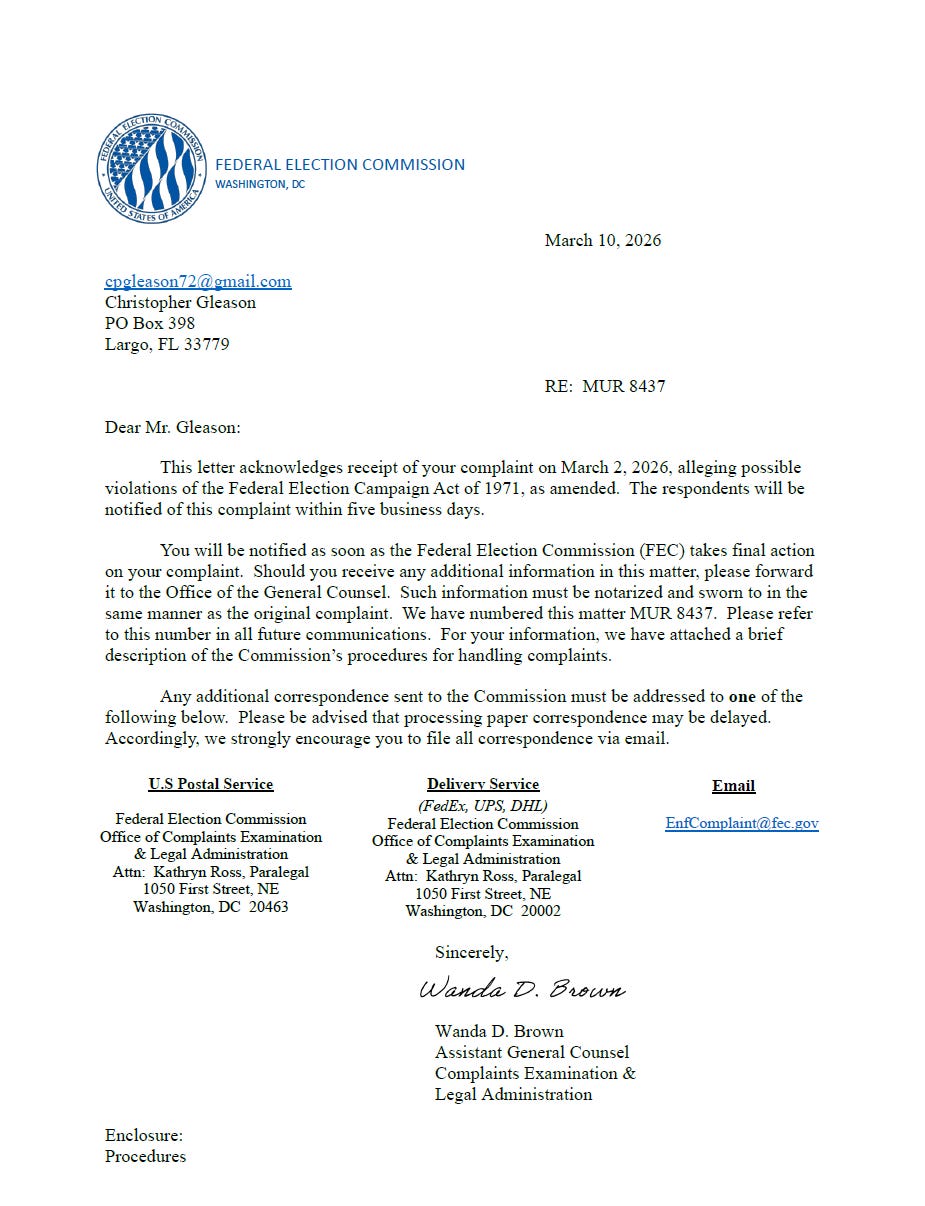
Eight days ago I received two letters from the Federal Election Commission. Each one confirmed that the FEC had received my complaints, assigned them Matter Under Review numbers, and would notify respondents within five business days.
MUR 8437 names Ashley Moody, her principal campaign committee Moody For Florida, her joint fundraising committee Ashley Moody Victory Fund, her disbanded Florida state PAC Friends of Ashley Moody, its successor Protect Florida PAC, and WinRed, Inc. as conduit co-respondent.
MUR 8439 names the iGas Clean Energy contribution network, including iGas USA, Inc. and affiliated entities controlled by CEO Xianbin “Ben” Meng, for violations arising from the company’s CCP-linked political contributions.
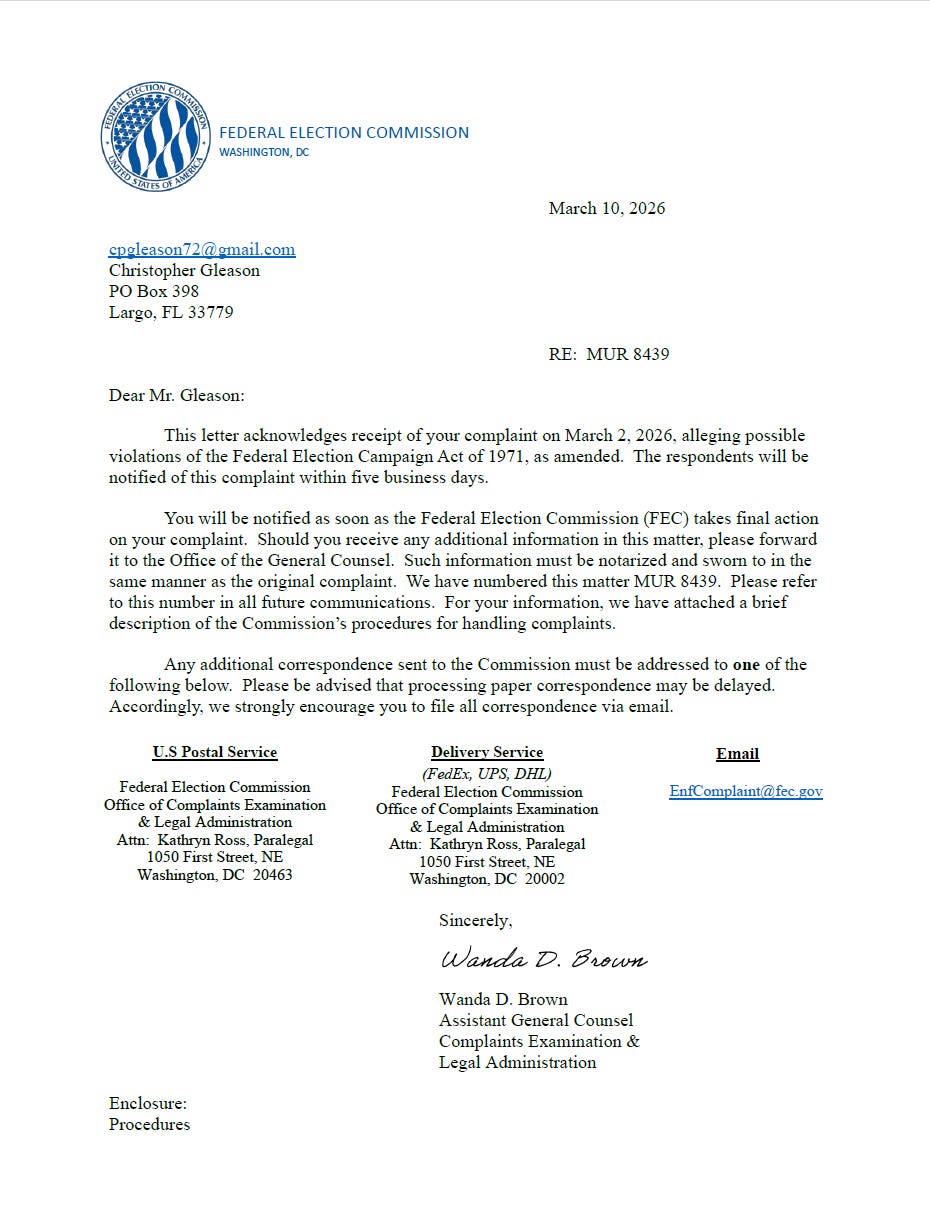
Both complaints were filed March 1, 2026, notarized in Pinellas County, and submitted under penalty of perjury. Both were acknowledged March 10, 2026, by Wanda D. Brown, Assistant General Counsel of the FEC’s Complaints Examination and Legal Administration office.
I am filing these as a declared candidate for the United States Senate in Florida, running against Ashley Moody in the 2026 Republican primary. I have standing as a direct competitor suffering concrete injury from the violations alleged. I also have standing as an American who spent three years building the forensic infrastructure to document what is in these complaints, and who is not going to stay quiet about it.
Here is what the FEC now has in front of it.
What MUR 8437 Alleges Against Ashley Moody
The Moody complaint identifies six distinct violations of the Federal Election Campaign Act.
The first and most significant is the illegal transfer of $3.85 million in soft money. When Moody became a federal candidate in January 2025 following her appointment to the Senate, she was subject to FECA’s prohibition on raising or spending funds that do not comply with federal contribution limits. Within weeks of that appointment, Friends of Ashley Moody, the Florida state PAC she established, financed, maintained, and controlled, formally disbanded and transferred $3.85 million to Protect Florida PAC, a successor committee chaired by the same person (Melanie Bonanno) with the same treasurer (Rich Heitmeyer). Protect Florida PAC subsequently transferred $6.69 million to an entity called Stronger Safer Nation.
This is not a novel legal theory. It is the same playbook Ron DeSantis ran when he transferred $82.5 million from Friends of Ron DeSantis to Never Back Down, Inc. before declaring his presidential candidacy. The Campaign Legal Center filed FEC complaints about the DeSantis transfer in 2023. The FEC, deadlocked 3-3 along partisan lines, took no enforcement action. Moody and her advisors watched that outcome and copied the structure at a smaller scale.
The friends of Ashley Moody PAC raised $14.4 million over its existence. That total included $330,000 from the Voice of Florida Business Political PAC, $307,500 from Florida Jobs PAC, $135,000 from Altria, $130,000 from TECO Energy, $125,000 from Publix Super Markets, $110,000 from Southern Glazer’s Wine and Spirits, and contributions from dozens of other corporations and entities that cannot legally contribute to federal candidates. All of that money was swept into the $3.85 million transfer.
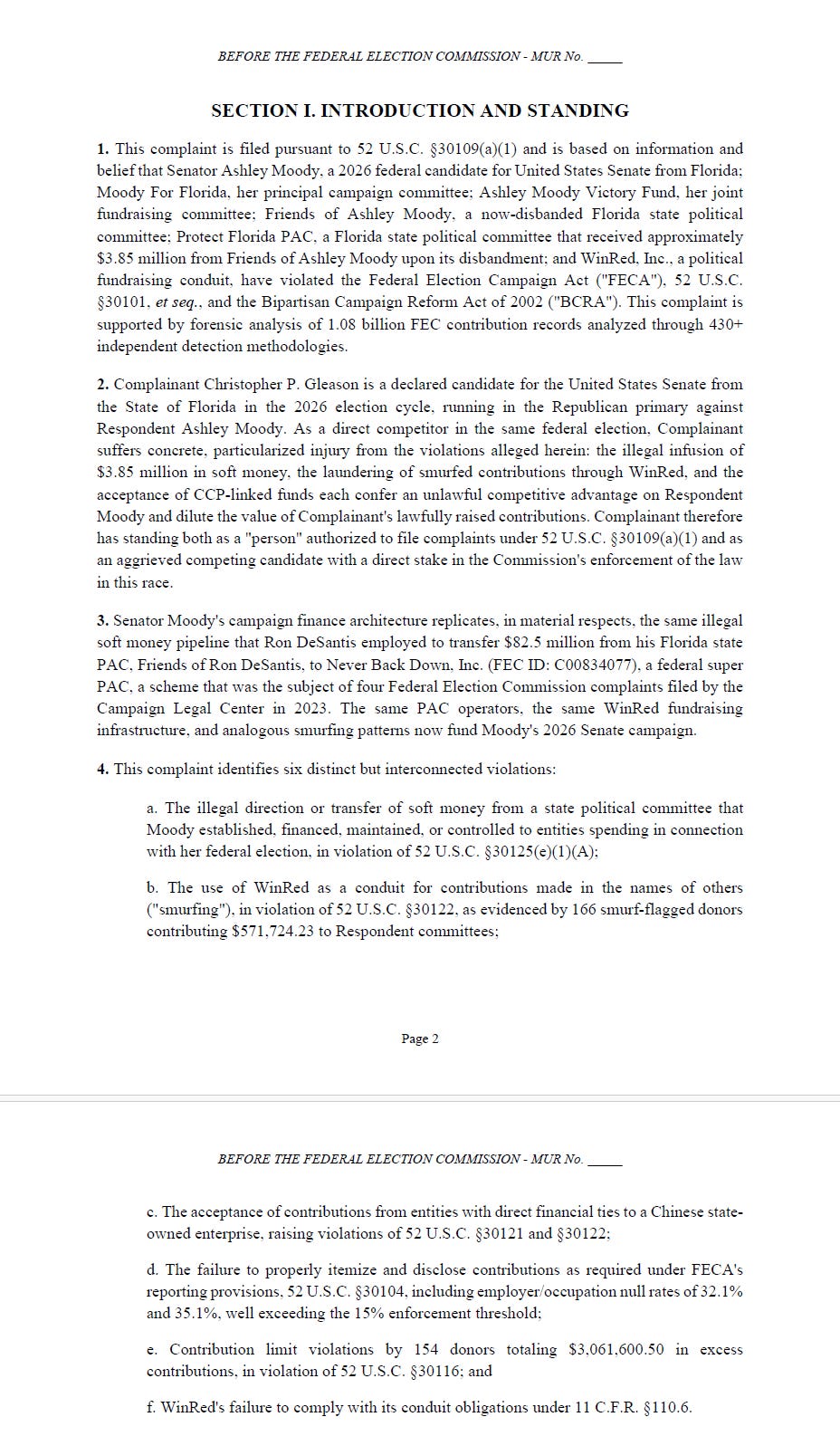
The second count is smurfing through WinRed. Smurf Hunter V4, the forensic platform I built to analyze over one billion FEC contribution records using 430 detection methodologies, identified 166 donors contributing $571,724.23 to Moody For Florida and the Ashley Moody Victory Fund who are classified as smurf donors based on their FEC-wide contribution patterns. Two are in the IMPOSSIBLE tier, meaning they have made more than 10,000 lifetime contributions across federal committees. Four are in the EXTREME tier (5,000 to 9,999 contributions). The behavioral signatures are not ambiguous.
Mollie Brown of Little Mountain, South Carolina has 29,616 total FEC contributions averaging $14 each across 122 committees. That is one contribution every 3.9 hours, around the clock, for years. Angela Williams of Palm Beach has 13,001 contributions totaling $2.6 million across 305 committees. Barbara Patterson of Gulf Breeze has 9,468 contributions at a rate of 18.67 per day, meaning she would need to submit a political contribution every 77 minutes, 24 hours a day, 365 days a year, to produce that record.
These are not enthusiastic small-dollar donors. These are the behavioral signatures of automated transaction systems generating synthetic contributions under real people’s names. That is a federal crime under 52 U.S.C. § 30122 regardless of which party benefits from it.
The third count is the foreign national contribution problem, which connects directly to the second complaint and is addressed below.
The fourth count is disclosure failure. Both Moody committees have null employer and occupation rates of 32 to 35 percent on contributions over $200, more than double the 15 percent threshold that triggers enhanced FEC scrutiny. The “best efforts” standard under FECA is not a suggestion. A one-in-three failure rate on required disclosures is not best efforts by any reasonable reading.
The fifth count is contribution limit violations. Analysis identified 154 donors who exceeded the $3,500 per-election limit for the 2026 cycle, totaling $3,061,600.50 in excess contributions.
The sixth count is WinRed’s failure to comply with its conduit obligations under 11 C.F.R. § 110.6. WinRed processed these contributions. WinRed has affirmative obligations as a conduit. A federal court ruled in January 2026 that the FEC had illegally failed to act on transparency petitions regarding WinRed’s reporting failures. WinRed is named as a co-respondent.
Across all four of Moody’s Florida state accounts, 3,148 out of 6,991 unique donors, 45 percent, matched the Smurf Hunter smurf index. That means the soft money that was transferred to Protect Florida PAC was itself contaminated at nearly a one-in-two rate before it ever entered the federal pipeline.
What MUR 8439 Alleges Against the iGas Network
The iGas complaint is the one that has national security implications.
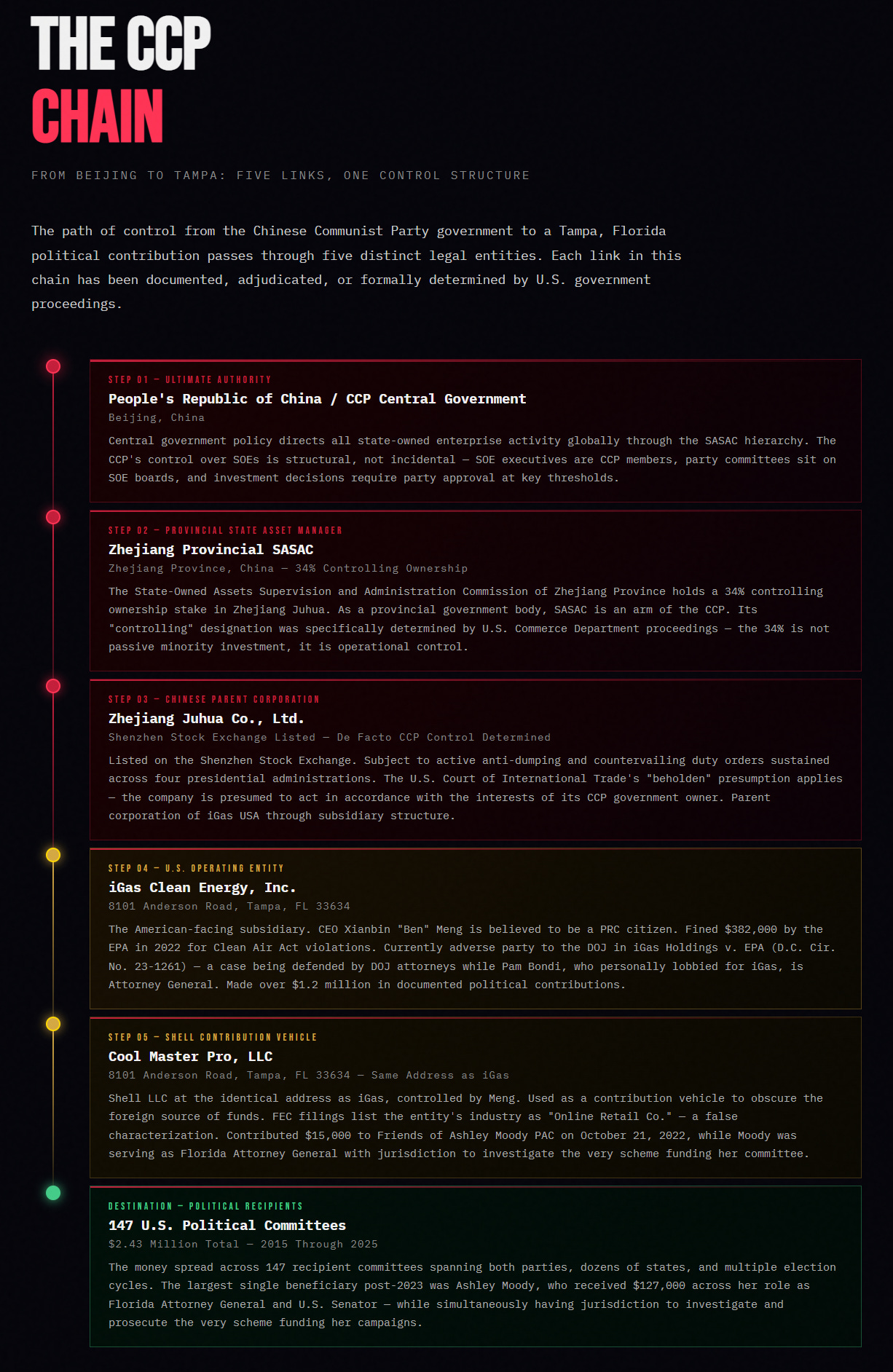
iGas Clean Energy, Inc. operates out of 8105 Anderson Road in Tampa. Its founding partner is Zhejiang Juhua Co., Ltd., which holds a 34% ownership stake financed through a $10 million capital infusion under a formal joint venture agreement. Zhejiang Juhua is controlled by Zhejiang Provincial SASAC, a state organ of the People’s Republic of China. The United States Department of Commerce formally determined in 2017 that iGas operates under de facto control of the Chinese Communist Party. That determination has been reviewed and sustained under four consecutive presidential administrations and has survived federal court challenge.
Despite that determination, Ballard Partners registered iGas under the Lobbying Disclosure Act in December 2023, not under the Foreign Agents Registration Act that the de facto CCP control determination plainly triggers. Ballard Partners is the firm founded by Brian Ballard, who simultaneously employed both current White House Chief of Staff Susie Wiles and current Attorney General Pam Bondi before their government appointments. Ballard’s Qatar FARA filing lists Bondi as key personnel. Bondi personally lobbied for iGas while at Ballard. She then gutted FARA enforcement on her first day as Attorney General, narrowing it to “traditional espionage” cases. She now controls the FARA Unit, the DOJ’s defense of the EPA in iGas v. EPA, and the Rivera prosecution that established the legal theory under which iGas’s political contributions potentially constitute criminal proceeds.
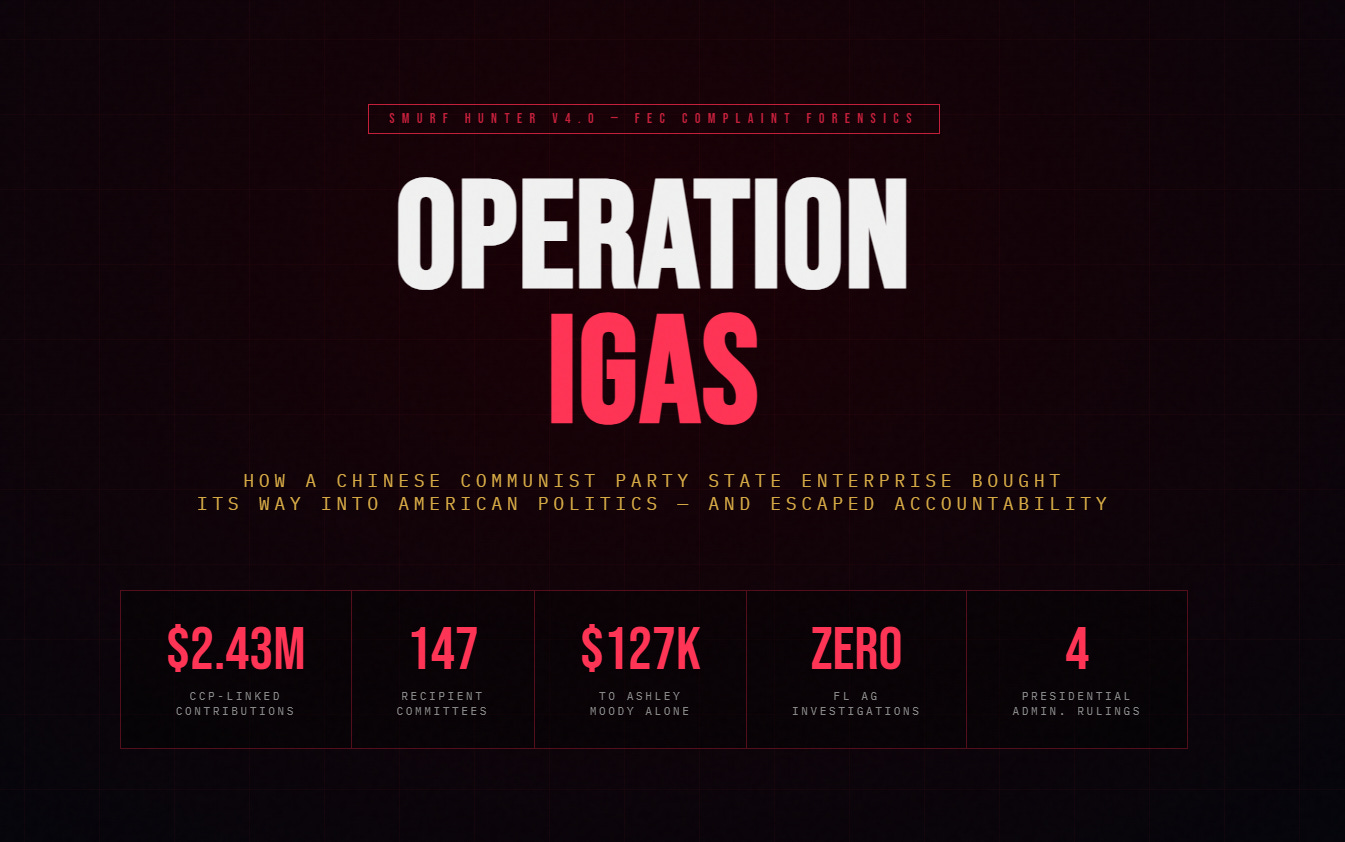
From 2016 through 2025, the iGas and Meng contribution network made more than $2.43 million across 147 political committees. The Miami Herald confirmed in 2023 that 98 percent of those contributions went to Republican candidates and committees. Smurf Hunter’s extended analysis of 2,509 transaction records through 2025 shows the pattern accelerated after the Herald’s reporting.
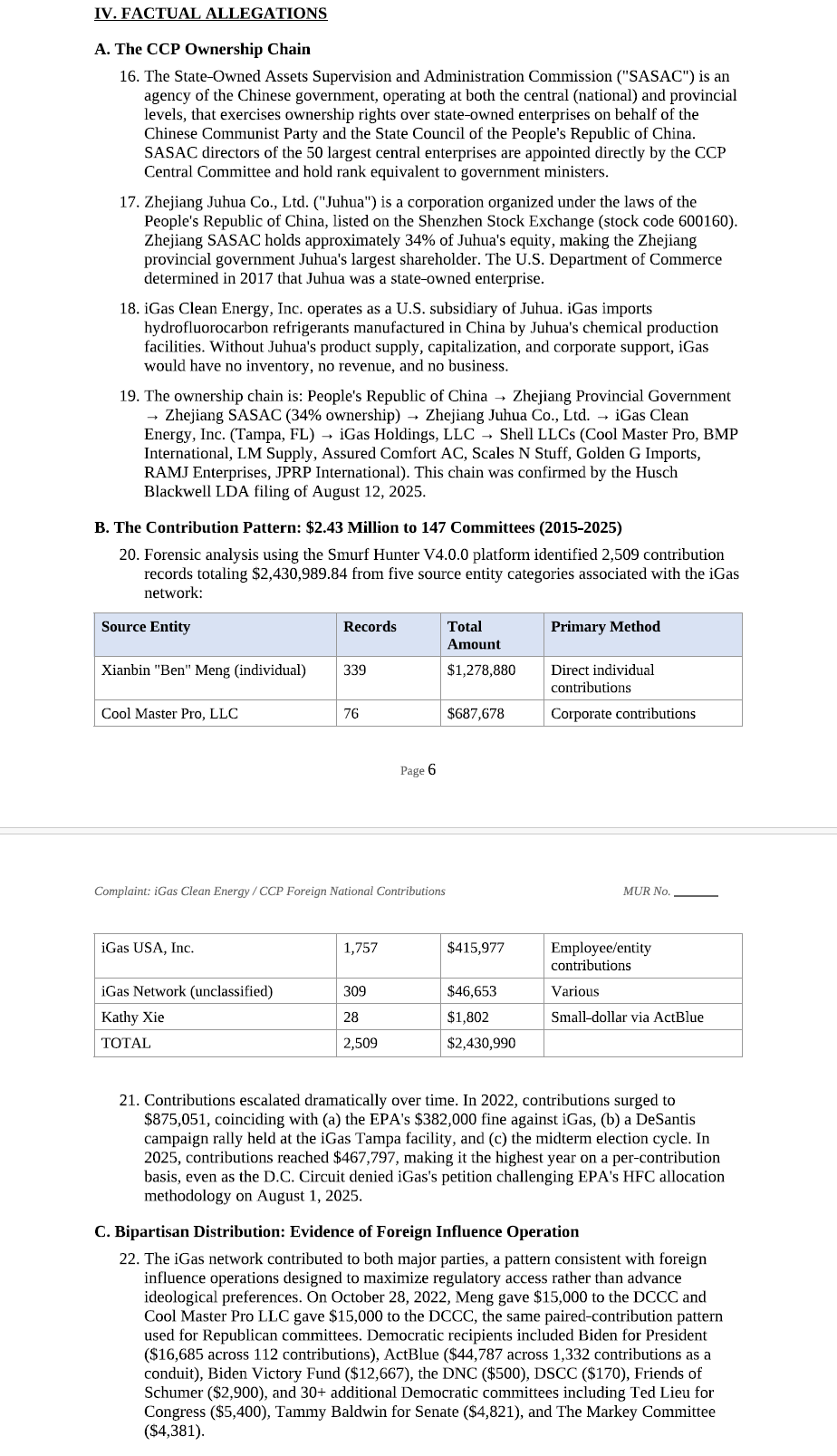
The recipients include the people running Florida and the people who want to run it next.
Ron DeSantis received approximately $340,000, the single largest individual total in the network’s contribution history. He held a campaign rally at the iGas Tampa facility in 2022 and accepted a personal check of more than $11,000 from CEO Xianbin Meng in August 2023 while running for president on an explicit anti-China platform.
Ashley Moody received $65,000 to Friends of Ashley Moody ($50,000 from iGas directly and $15,000 from Cool Master Pro LLC, a shell company at the same Tampa address also controlled by Meng) plus $62,000 in federal committee contributions in 2025, totaling $127,000. As Florida’s Attorney General from 2019 to 2025, Moody had jurisdiction under Florida law to investigate foreign-controlled entities making political contributions. She opened zero investigations.
Jay Collins, Florida’s Lieutenant Governor, received $50,000 from iGas deposited into his Quiet Professionals FL committee on October 29, 2025, twenty-six days after he signed the committee’s formation paperwork. Collins is now running for governor using that committee.
Byron Donalds, Trump’s endorsed candidate for Florida Governor and the current polling front-runner, received $450,000 from the Meng and iGas network for his gubernatorial campaign. Donalds has described China as America’s “top hegemonic adversary” throughout his congressional career. The Washington Examiner reported the Donalds connection in January 2026.
These $65,000 in iGas and Cool Master Pro contributions to Friends of Ashley Moody did not sit in an account that was subsequently closed and audited. They became part of the $3.85 million that was transferred to Protect Florida PAC on February 18, 2025. CCP-linked capital is now commingled with funds being deployed in connection with a United States Senate election.
The FEC’s investigation in MUR 8439 should determine whether Zhejiang Juhua, through its ownership interest, board representation, or joint venture governance mechanisms, directly or indirectly participated in the decision to make these political contributions. If it did, that is a violation of 52 U.S.C. § 30121. If the LDA registration was the wrong filing and FARA was required, then under the legal theory the DOJ is currently prosecuting in United States v. Rivera, the lobbying fees Ballard collected and the $2.43 million in downstream political contributions are potentially proceeds of an unregistered foreign influence operation.
What Happens Next: The Quorum Problem, the Clock, and What I Can Do About It
The FEC notified respondents within five business days of March 10. Ashley Moody’s campaign committees, WinRed, and the iGas network respondents have 15 days to file written responses arguing why no action should be taken. Those responses are now due.
Here is the problem with what comes after that.
The Federal Election Commission has not had a policymaking quorum since May 1, 2025. That is ten months and counting. As of today, only two commissioners are seated: Chair Shana Broussard and Commissioner Dara Lindenbaum, both Democrats. FECA requires four agreeing votes to open an investigation, issue penalties, authorize subpoenas, enter conciliation agreements, or take virtually any substantive enforcement action. The agency currently cannot do any of those things.
This is not an accident. Trump fired Commissioner Ellen Weintraub on January 31, 2025, in what many legal scholars argue was an unlawful removal, the first in the FEC’s fifty-year history. Commissioner Cooksey resigned the same month to serve as counsel to the Vice President. A third vacancy followed in the spring. By October 3, 2025, the FEC’s lone remaining Republican commissioner, Trey Trainor, resigned to run for Congress in Texas. The agency dropped from three commissioners to two and lost even its bipartisan representation.
Trump nominated two Republicans, Ashley Stow and Andrew Woodson, on February 11, 2026. Those nominations are pending Senate confirmation. Restoring a quorum requires confirming both of them with no further vacancies, and even then the commission would operate at a bare minimum of four, meaning every enforcement decision would require unanimous agreement between two Republicans Trump just nominated and two Democrats who have watched their agency get systematically dismantled for the past year.
The outlook for contested enforcement is not good.
There is also a clock running that does not care about quorum. FECA imposes a five-year statute of limitations on violations. Some of the iGas contributions I documented go back to 2016 and 2017. Those oldest transactions may already be time-barred. The FEC’s own inspector general reported that when the quorum lapsed in 2025, 115 matters already in the enforcement backlog contained allegations that would expire under the five-year limit within 18 months. Every month the commission sits paralyzed, that window narrows.
Trump publicly told Republican senators that he wants the SAVE America Act prioritized above all other Senate business, including confirmations, telling them he would support holding up every confirmation for six months if that is what it takes. If that posture holds, the two pending FEC nominees may not be confirmed before the 2026 primary election is effectively over.
So what can I do as a harmed complainant when the agency that is supposed to act cannot?
More than people realize.
The first and most significant remedy is the three-step federal court pathway under 52 U.S.C. § 30109(a)(8), and it ends with the ability to sue Ashley Moody, her campaign committees, WinRed, and the iGas network directly in federal court.
Step one: after the FEC fails to act within 120 days of my complaint filing, I have the right to sue the FEC itself in the United States District Court for the District of Columbia. That window opens in late June 2026. The court can declare the FEC’s failure to act “contrary to law” and direct the Commission to conform within 30 days.
Step two is where the quorum problem becomes the respondents’ problem, not just the FEC’s. Without a quorum, the FEC cannot muster four votes to conform to the court’s order. It also cannot muster four votes to defend itself in the lawsuit in the first place. Under FECA, the FEC needs four affirmative votes to authorize its own General Counsel to litigate on the agency’s behalf. A two-commissioner FEC cannot defend itself in federal court.
Step three is the remedy Congress specifically built into the statute for exactly this situation. Under 52 U.S.C. § 30109(a)(8)(C), if the FEC fails to conform to the court’s order within 30 days, the complainant may bring a direct civil action against the named respondents themselves to remedy the violations in the original complaint. This is not a theoretical remedy. The Campaign Legal Center used this exact mechanism in January 2023, filing a direct lawsuit against Correct the Record and Hillary for America after the FEC failed to conform to a court remand order. The case was litigated in federal court against the private respondents, not the agency.
That means the pathway to suing Ashley Moody’s campaign committees, WinRed, and the iGas network directly in federal court runs through the FEC’s inability to act, which is precisely the condition that currently exists. The quorum crisis that was engineered to protect the respondents from FEC enforcement is the same mechanism that, if I follow the statute to its conclusion, strips the FEC out of the equation entirely and puts the named parties in front of a federal judge on the merits of the violations.
The second remedy involves the Department of Justice’s independent criminal enforcement authority. A quorum loss at the FEC does not affect DOJ’s ability to prosecute knowing and willful violations of FECA. 52 U.S.C. § 30109(d) is a criminal statute, and the DOJ does not need an FEC referral to open a criminal investigation. The FEC’s own legal analysis confirms this: an FEC quorum loss has no bearing on DOJ criminal enforcement. The problem here, as documented throughout this article, is that the DOJ is run by Pam Bondi, who lobbied for iGas, gutted FARA enforcement on day one, and controls every institutional mechanism through which criminal accountability for this network would otherwise flow. The DOJ pathway is compromised. I am documenting it publicly, not because I expect Bondi to act, but because the record of her inaction is itself evidence of the conflict I have already described.
The third remedy is congressional referral. The complaints are on file and public. I am transmitting complete documentation to the Senate Judiciary Committee, the Senate Foreign Relations Committee, and the House Judiciary Committee. The iGas matter has particular relevance to the Senate Foreign Relations Committee given the FARA implications and the active Commerce Department de facto CCP control determination. The committee has direct jurisdiction over questions of foreign agent registration and foreign government influence operations in American elections. The record will be placed before it.
The fourth remedy is the Treasury Department and OFAC pathway for the foreign national contribution question. If Zhejiang Juhua’s governance structure gave it direct or indirect authority over the political contribution decisions of iGas USA, that is potentially an OFAC sanctions compliance issue in addition to a FECA violation. I am referring the CCP ownership chain and contribution pattern to the appropriate Treasury channels independently of the FEC process.
The fifth remedy is continued public record-building. Smurf Hunter V4 generates new analysis continuously. I have reserved the right to supplement both MUR filings with additional exhibits that relate back to the original filing date. Every new FEC filing by Moody’s committees after the date of service creates a new knowing-and-willful exposure if smurf-tier donors continue to be accepted. I will be monitoring and documenting every filing.
The FEC is broken. That is deliberate. The same administration that benefits from weakened campaign finance enforcement has spent fourteen months ensuring the agency cannot function. The quorum was not lost by accident. The Weintraub firing, the delayed nominations, and Trump’s open instruction to the Senate to prioritize his voter ID bill over all confirmations are a coherent strategy, not a series of unrelated personnel decisions.
None of that ends the case. It routes it through different channels.
The 120-day clock runs. The federal court option is available. The congressional record is being built. The foreign national contribution question has a Treasury pathway that bypasses DOJ. The statute of limitations is the one constraint I cannot litigate around, and the record is clear: the longer the FEC remains paralyzed, the more of the iGas contribution history moves beyond the reach of civil enforcement.
That urgency is documented. The MUR numbers are assigned. The respondents are on notice. The evidence is sworn under penalty of perjury in Washington.
If you want to follow the cases, both MUR numbers are searchable on the FEC’s public database. MUR 8437 is the Moody complaint. MUR 8439 is the iGas complaint. All future correspondence with the Commission should reference those numbers.
Chris Gleason is a Florida Army veteran, co-founder of RealTruth.AI, Election Integrity Analyst with The Justice Society, and Republican candidate for the United States Senate in Florida challenging incumbent Ashley Moody in the 2026 Republican primary. The forensic analysis underlying the complaints described in this article was conducted using Smurf Hunter V4, a campaign finance forensics platform analyzing over one billion FEC contribution records. FEC complaint documentation is on file with the Commission and available upon request.
MUR 8437 (Ashley Moody): Filed March 1, 2026. Acknowledged March 10, 2026. MUR 8439 (iGas/CCP Network): Filed March 1, 2026. Acknowledged March 10, 2026. Both acknowledged by Wanda D. Brown, Assistant General Counsel, FEC Complaints Examination and Legal Administration
Once you finally understand that you’re being governed by criminals, it all makes sense. Nobody above a certain level in politics is ever prosecuted because all career politicians are dirty. It’s only the illusion of accountability that we see each day. These are dark times…